Memory Keeping
How to catch up on a baby book when you're already behind
Behind on your baby book? Use this practical, low-pressure method to recover photos, dates, quotes and stories without rebuilding every missing month.
The baby book began with excellent intentions.
Birth details: complete. First smile: carefully dated. First tooth: possibly recorded. Then the entries stop, usually around the same time the baby learned to move independently and the adults stopped completing tasks in one sitting.
Now the child is two, five, or nine. The book is in a cupboard, and opening it feels less like preserving memories and more like reviewing evidence for a case against yourself.
You do not need to reconstruct every missing month. You need a small, repeatable way to recover the stories that still matter—and a simpler system for keeping new ones.
The short answer
To catch up on an unfinished baby book:
- Do not begin at birth. Start with the easiest recent year.
- Choose a small rescue target, such as 12 meaningful memories.
- Use your camera roll, messages, calendar, and family chats as memory prompts.
- Save the story behind each photo, not a complete record of every event.
- Use the original date when known and an honest approximate date when it is not.
- Stop after 15 or 20 minutes, then return another day.
- Begin capturing new memories now instead of waiting until the backlog is finished.
The backlog does not need to be cleared before ordinary family life is allowed to continue. This is fortunate, because ordinary family life has not been waiting for permission.
First, change what “caught up” means
A traditional baby book suggests that a complete childhood record has one entry for every milestone, every month, every birthday, and perhaps every tooth.
That is a lovely object. It is also a demanding administrative relationship.
Your child will not measure the value of their memories by whether month 17 received equal coverage. They are more likely to care about the stories that reveal what they were like: the song they sang constantly, the toy that went everywhere, the question that stopped dinner, the friend they adored, the phase when every cardboard box became public transport.
Being caught up does not mean filling every blank. It means recovering enough true moments that the child feels recognizable on the page.
Set a rescue target you can finish. Twelve memories is useful. Fifty is a project. “Everything” is how the book returns to the cupboard.
Do not start with the oldest gap
Chronological order feels sensible, but it creates the hardest possible first task. The oldest memories are usually the least accessible. You spend twenty minutes trying to determine whether a photograph was taken before or after the first haircut, then decide to make tea.
Start with the easiest period instead:
- The past year, because the stories are still familiar
- A recent holiday or birthday
- A month with many photographs
- The year your child started school
- A phase the whole family still talks about
Completing a small section gives you a working system. You can move backward later without making historical accuracy a condition for beginning.
It is a family memory book, not a tax return. Approximate dates will not trigger an investigation.
Build a memory map before writing
Do not open a blank page and demand that your brain produce several years of childhood on command. Use the records you already created accidentally.
Spend ten minutes making a rough memory map. List years or ages, then add any anchor you remember:
- Homes you lived in
- Nursery or school years
- Birthdays and holidays
- Trips and family visits
- Favorite toys, books, foods, and clothes
- Friendships and teachers
- Recurring jokes or phrases
- Illnesses, missing teeth, broken arms, or dramatic bandages
- New skills and interests
- Family changes
These anchors give other memories somewhere to attach. Once you remember the dinosaur birthday cake, you may also remember that your child refused all food except plain rice that month and introduced every adult as “my worker.”
Write fragments, not polished entries. The map is a set of clues.
Mine the places where memories are already hiding
Most parents have documented more than they think. The problem is that the evidence is scattered across several apps and at least one chat containing 4,000 photographs of the same grandchild.
Your camera roll
Scroll by month rather than through the entire library. Choose photographs that prompt a story, not simply the best-looking images.
A blurred photo of your child wearing swimming goggles at breakfast may be more useful than the formal birthday portrait. The blur contains a phase. The portrait contains a cake you already remember.
For each chosen image, ask:
- What was happening just before or after this?
- What did my child call this person, object, or place?
- Was this a habit, obsession, fear, or joke at the time?
- What would the photograph fail to explain on its own?
Write that answer. The photo already handles the lighting.
Family messages
Search chats for your child's name, common phrases such as she said, he asked, first, finally, or the names of grandparents and schools. Voice notes and messages sent in the moment often contain details you no longer remember.
Use them as prompts. Do not copy another person's private message into a keepsake without permission, and do not assume every family chat needs to become archival material. Some conversations have served their purpose.
Calendars and email
Calendars recover dates for appointments, trips, school events, performances, and visits. Email can help with registrations, travel confirmations, and school notices.
These sources are useful for placing a memory in time, but the event itself is not always the story. “School concert, 14 December” is a fact. “She waved at us through the entire song and missed every second line” is the memory.
Grandparents and other caregivers
Ask one specific question rather than “What do you remember?”
Try:
- What did they always do at your house that year?
- What was the funniest thing they called you?
- Which game did they ask to play every visit?
- What food did they insist tasted different at your house?
Specific questions retrieve specific stories. General questions often retrieve, “Oh, there were so many,” followed by tea.
Use the 12-memory rescue plan
If the backlog feels large, recover one year with twelve entries:
- One phrase or mispronunciation
- One question they asked
- One ordinary routine
- One favorite object
- One friendship
- One family relationship
- One fear or challenge
- One new skill
- One proud moment
- One completely unremarkable day you still remember
- One photo with an important story behind it
- One detail about their personality at that age
This is not a mandatory template. It is a way to avoid using all twelve entries on birthdays and official milestones.
Childhood contains achievements, but it also contains the year a child wore a cape to the supermarket for six consecutive Saturdays. The cape deserves representation.
If twelve still feels like too much, choose six. A smaller record that exists is more useful than a comprehensive one that remains mentally scheduled for next weekend.
Write the minimum useful entry
A memory does not need three pages of reflection. Use four parts:
- Date or approximate date
- Child's age
- What happened or what they said
- One line of context
For example:
Around March 2023 — age three
Every morning, Leela packed two wooden blocks into a small bag before preschool. She called them her “office things” and became concerned if anyone touched them.
That is enough. It preserves the object, phrase, routine, and seriousness of the phase without requiring you to remember which Monday it began.
If you know only the season or school year, say so. Summer 2022 is honest. A confidently invented date is tidy but not especially helpful.
Backdate without pretending you remember everything
When a tool allows backdating, use the date the memory happened rather than the day you finally entered it. This keeps the child's age and timeline meaningful.
Use an exact date when it appears in a photo, message, calendar, or document. Otherwise, choose the nearest honest estimate and make the uncertainty visible in the note.
Useful labels include:
Around age fourSummer 2024During the first term of schoolA few weeks after we moved
Do not discard a good story because its timestamp would not satisfy a museum registrar.
The purpose of the date is orientation, not courtroom evidence.
Separate recovery from curation
Trying to capture, edit, design, organize, and choose the final keepsake layout in one session makes every memory expensive.
Use two stages:
Stage 1: Recover
Save the rough memory with its date, child, words, and context. Attach the useful photo, video, or voice note if you have one. Do not spend ten minutes choosing between two nearly identical photographs.
Stage 2: Curate later
Mark the entries that belong in a future book, birthday collection, or family share. Edit wording only when you actually create that keepsake.
This keeps the first step light. It also prevents the deeply parental experience of spending an evening adjusting a photo crop while forgetting the sentence you meant to preserve.
Catch up in short sessions
Set a timer for 15 or 20 minutes. Work on one month, event, or memory type. Stop when the timer ends, even if the camera roll has begun offering material from 2019.
A useful session might produce only three entries. That is progress.
Long catch-up sessions tend to create two problems: exhaustion and increasingly weak editorial judgment. By hour two, every photograph looks historically significant, including fourteen images of the same pancake.
Short sessions make it easier to return. One session a week for a month can recover a meaningful set of memories without turning the project into a second household to manage.
Do not pause the present while repairing the past
The most important rule is to capture new moments now.
If your child says something worth keeping today, save it today. Do not place it behind four years of unfinished administrative history.
Run two small habits at the same time:
- Forward habit: Save one current quote, question, moment, or milestone when it happens.
- Backfill habit: Recover two or three older memories during a short weekly session.
The present stays current while the past improves gradually. Eventually the gap becomes smaller without requiring a dramatic weekend intervention involving snacks, chargers, and emotional negotiations with cloud storage.
What if you have more than one child?
Use one family inbox, then assign each recovered memory to the child whose story it mainly tells. Tag shared sibling memories consistently rather than duplicating everything.
Do not aim for identical numbers. Look for meaningful coverage of each child's words, relationships, interests, routines, and personality.
For a complete system, read How to organize childhood memories for multiple children.
How Kiddings helps with older memories
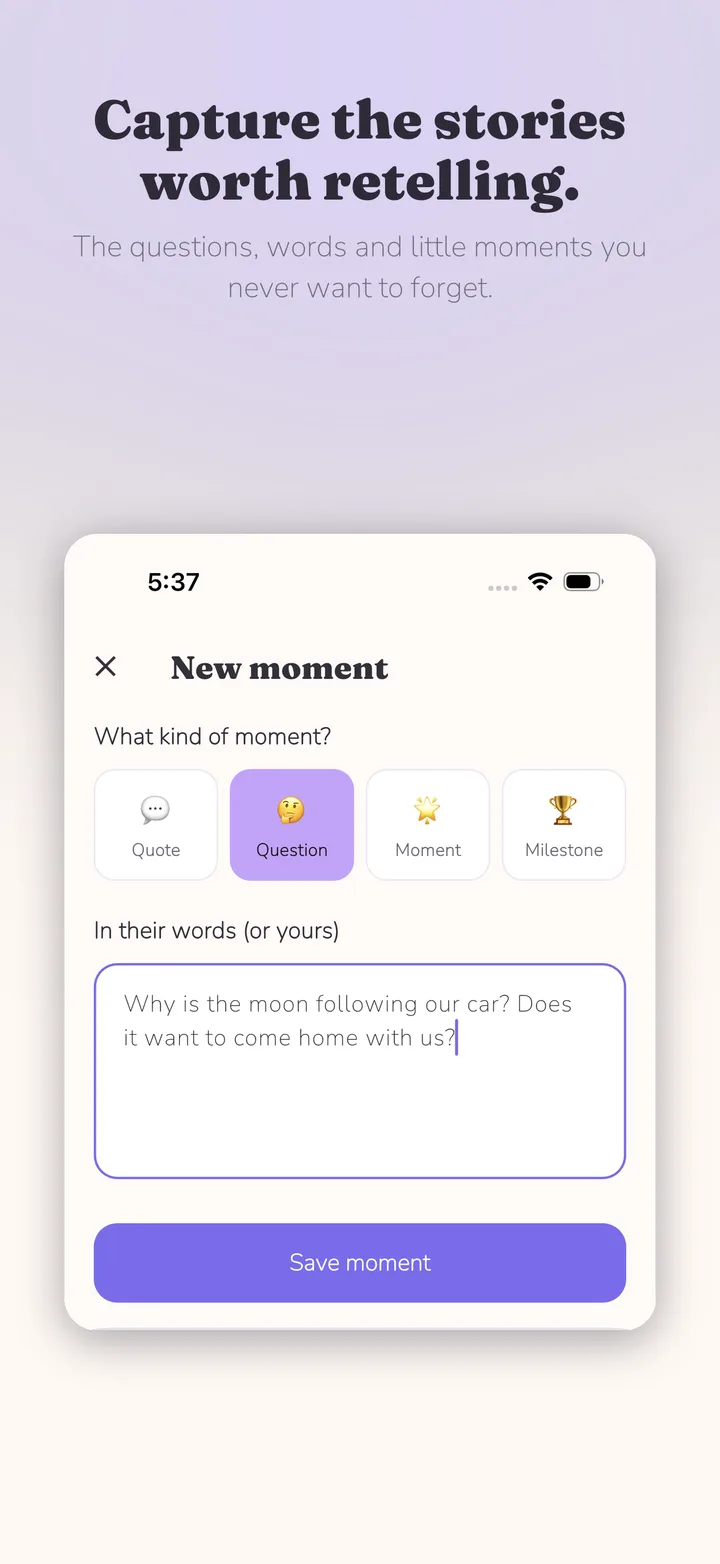
Kiddings is a private parenting journal for saving quotes, questions, everyday moments, and milestones alongside text, photos, videos, and voice notes.
You can choose the relevant child and backdate an older memory so it appears in the right part of the timeline with the child's age at the time. Search, filters, favorites, and tags such as Noteworthy and For Book help separate quick recovery from later curation.
Kiddings supports multiple child profiles, a combined family timeline with per-child views, and invitations for selected family members. It has no public feed and is ad-free. Chosen memories can be exported as a print-ready PDF keepsake.
Kiddings is available on the App Store and Google Play.
If time remains the main obstacle after you catch up, read How to keep a parenting journal when you have absolutely no time. For help choosing the memories worth rescuing first, see 20 things to record about your child before they grow up. And when you are ready to turn selected entries into something physical, read From scattered moments to a keepsake book your child can hold.
Frequently asked questions
Is it too late to start a baby book for an older child?
No. Begin with memories you can recover confidently from recent photos, messages, calendars, and family stories. Save a small selection with honest dates or approximate periods, then keep adding current moments as they happen.
How can I catch up on years of missing baby-book entries?
Work one year or event at a time and set a small target, such as six or twelve meaningful memories. Use your camera roll, chats, calendar, email, and relatives as prompts. Stop after 15 or 20 minutes and return another day.
What if I cannot remember the exact date of a childhood memory?
Use the closest honest estimate, such as a month, season, school term, or age, and label it clearly. An approximate date with a true story is more useful than omitting the memory or inventing precision.
Which old memories should I add first?
Prioritize memories that reveal personality: distinctive words, questions, routines, relationships, interests, fears, jokes, and ordinary phases. Add major milestones too, but do not let birthdays and firsts crowd out the details a photograph cannot explain.
Should I finish the backlog before adding new memories?
No. Capture current memories when they happen and recover older ones in separate short sessions. This prevents the backlog from growing while you gradually improve the earlier record.
Rescue one memory today
Choose one photograph from the past year. Add the original date, your child's age, and two sentences about what the image does not show.
Then stop.
You are not rebuilding childhood in an afternoon. You are making sure a few of its best stories do not remain trapped behind a thumbnail and a timestamp.

Bring one old memory back today.
Kiddings helps you backdate the words, photos and little stories you still want to keep.