Parenting & memory keeping
How to Keep a Parenting Journal When You Have Absolutely No Time
Want to preserve your child's funny quotes, milestones and everyday memories but never have time to journal? Here's a simple way to build a childhood journal you'll actually keep.
The beautiful baby journal in the cupboard
There is a very specific kind of optimism that makes a new parent buy a beautiful baby journal. You look at its thick paper, tasteful illustrations and neatly labelled sections—first smile, first tooth, first steps—and think: Yes. I am going to document this childhood properly.
Three years later, you find the book in a cupboard. You have filled in the birth weight. Possibly the first smile. Then apparently the child vanished until preschool.
This is extremely normal. The problem isn't that parents don't care about preserving childhood memories. Quite the opposite. The problem is that parenting produces memories significantly faster than parents have time to document them.
The good news is that keeping a parenting journal doesn't have to mean writing a diary every night. In fact, it probably shouldn't.
What is a parenting journal?
A parenting journal or childhood memory journal is simply a place where you save the things about your child that you want to remember later: funny things they say, strange questions, milestones, little habits, everyday family moments, photos, videos, voice recordings, proud moments and details that reveal their personality.
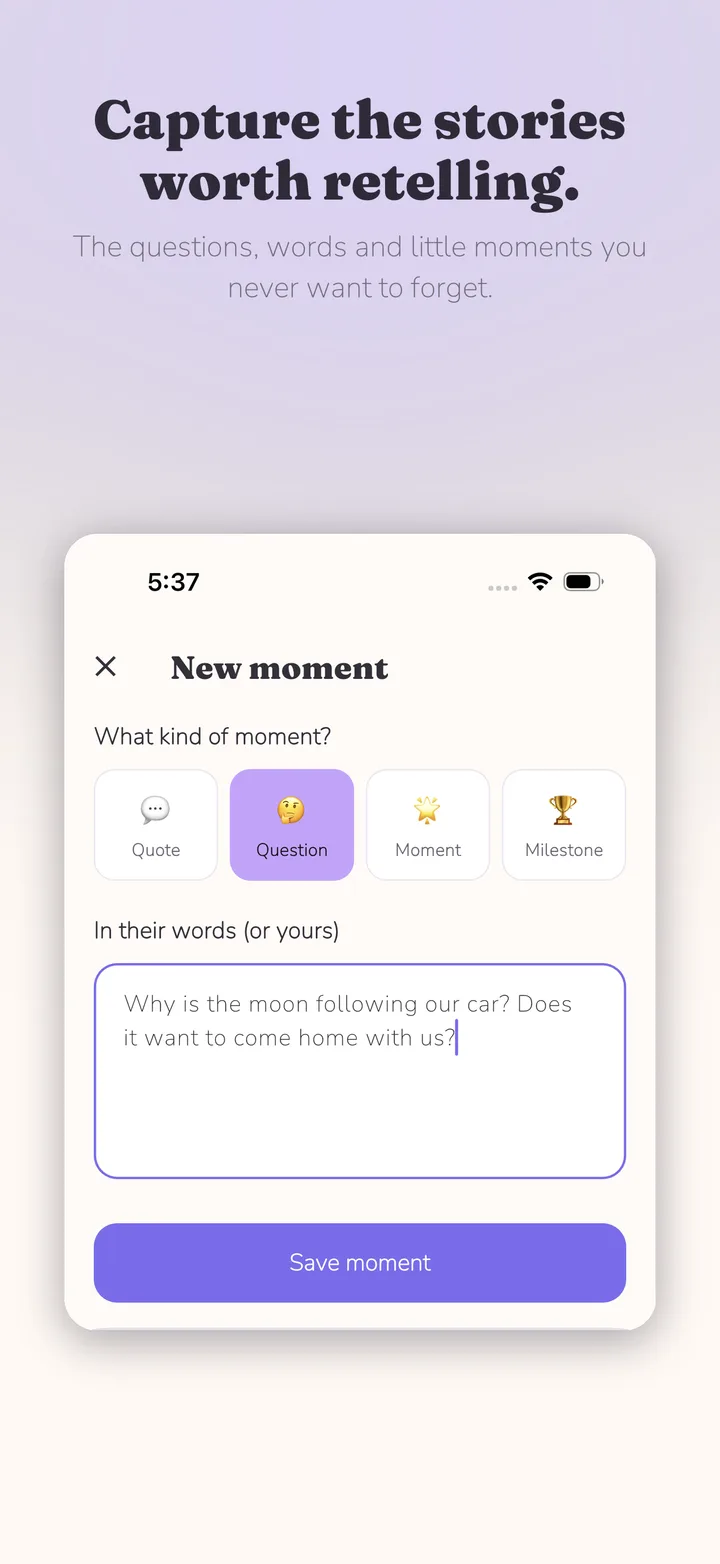
It doesn't have to be a beautifully written account of childhood. An entry can literally be: Age 4—asked why the moon keeps following our car and whether it wants to come home with us.
That's a journal entry. And twenty years from now, it may be far more interesting than knowing exactly which date tooth number seven appeared.
The mistake: trying to record everything
This is where a lot of baby books and parenting journals go wrong. They quietly turn memory-keeping into homework: record every milestone, add a photograph every month, answer 47 questions about your child's development, and remember the exact date they first rolled from their back onto their left elbow while facing north-west.
No wonder parents stop. You don't need a complete historical archive of your child's life. You need the bits you'll wish you remembered.
Think less like an archivist at the National Museum and more like somebody leaving breadcrumbs for their future self.
1. Things your child says
These are possibly the easiest childhood memories to lose. Kids temporarily develop their own language. Spaghetti becomes basketti. Mosquitoes become spaghettos. Yesterday means anything that happened between breakfast and the beginning of human civilisation.
Then one day they learn the correct words and never say the funny version again. Record it when it happens. Don't assume you'll remember. You won't.
Your brain is currently storing school schedules, grocery lists, passwords and the location of a water bottle your child insists you have personally hidden. Something has to go.
2. Questions they ask
Children ask genuinely wonderful questions because they haven't yet learned which questions adults have collectively agreed not to ask.
Why does the moon follow the car? Where was I before I was born? Do dogs know they're dogs? If dinosaurs are extinct, how do we know their names? Why do grown-ups have to work so much?
These questions often capture how your child understood the world at a particular age. A photograph can't really preserve that.
3. Temporary phases
Childhood is full of tiny eras. For six months they wear a superhero cape everywhere. Then it's dinosaurs. Then every drawing is a dinosaur. Then suddenly dinosaurs are embarrassing and they're interested in football or space or Taylor Swift or whatever has replaced your influence over their personality.
Write the phases down. They're surprisingly easy to forget once the next one begins.
4. Ordinary moments
First steps get recorded. Tuesday afternoons usually don't. But ordinary moments often become the memories parents miss most.
The way they climbed into your bed every morning. The ridiculous game you played during dinner. The song they demanded every time you drove somewhere. The battered stuffed rabbit they carried everywhere for two years.
Nothing happened. And that is exactly why you may never think to photograph or record it.
5. Moments that reveal who they're becoming
Sometimes a child says or does something and you suddenly see a little more of the person emerging underneath. Maybe they comfort another child, tell an unexpectedly sophisticated joke, or cheat spectacularly at Uno and then construct an elaborate legal defence.
Maybe they say: “Maybe grown-ups get scared too. They just don't tell children.” Those moments are worth saving.
Over time, they form something much richer than a list of milestones. They become a record of who your child was becoming.
The 30-second rule for childhood journaling
Here's a much more realistic system: if recording a memory takes longer than about 30 seconds, you're probably making it too complicated.
Something funny happens. Open your journal. Write one or two sentences. Save. Done.
For example: Age 5—saw a bald man in the supermarket and whispered, “Maybe his hair is still loading.” That's enough. You don't need to explain which supermarket, describe the weather, or add a profound reflection on the fleeting nature of childhood. Future you will understand.
What if I've already missed years?
This is another reason parents avoid starting: “My child is already six. I should have started when she was born.” No. Start at six.
There is no governing body for childhood journals. Nobody will inspect your records and revoke your parenting licence because 2022 is suspiciously empty.
You can also backfill memories whenever they occur to you. Maybe your child is eight and you suddenly remember that, at three, she called helicopters sky fans. Write it down now. An imperfect memory preserved late is still better than a perfect memory lost forever.
You don't have to journal every day
A good parenting journal is not necessarily a daily journal. Daily journaling sounds admirable. So does waking at 5 a.m. to meditate. Many admirable things remain admirably undone.
For childhood memories, consistency matters far less than longevity. Saving two meaningful moments a week for ten years gives you more than 1,000 memories. Even one moment a week gives you more than 500.
Imagine opening a book containing 500 tiny stories from your child's childhood. You probably won't be upset that Tuesday, March 14 was missing.
Photos are wonderful. But photos aren't enough.
Parents already take extraordinary numbers of photos. And that's good. Photos preserve what childhood looked like, but they don't always preserve what childhood felt like.
A photograph might show your daughter sitting at breakfast. It doesn't tell you that, for four months, she insisted toast tasted better when cut into triangles because “squares are too serious.” A video might show your son riding his bicycle. It may not tell you that he spent the previous week announcing that helmets were “basically hats with jobs.”
A childhood journal doesn't have to replace your camera roll. It complements it. Photos preserve faces. Short notes preserve stories. Voice recordings preserve voices. Videos preserve movement. Together, they create something much closer to a childhood.
Where should you keep childhood memories?
There isn't one correct answer. Paper journals and baby books are beautiful and tangible, but harder to maintain and search. Apple Notes and Google Keep are fast and free, although memories can become buried among grocery lists and Wi-Fi passwords.
Google Photos and Apple Photos are excellent for photographs and videos, but less suited to text-only moments, questions and funny quotes. Private family albums help when sharing photos with relatives is the main goal. Dedicated parenting journals and kids memory book apps are designed specifically around children, ages, memories and milestones.
The best system is the one you're actually going to use. The best childhood journal isn't the prettiest one. It's the one you keep adding to.
A simple childhood memory system
If you want to start today, don't create an elaborate project. Use this rule: whenever something makes you think, “I want to remember this,” save it. That's it.
Don't decide whether it is important enough. Don't organize it perfectly. Don't wait until tonight.
Because tonight has a remarkable habit of becoming tomorrow. And tomorrow eventually becomes: “What was that hilarious thing she used to say when she was four?”
Why I built Kiddings
This problem is why I started building Kiddings. I wanted something between a camera roll and a traditional baby book—a place where I could quickly save quotes, questions, everyday moments, milestones, photos, videos and voice notes without feeling as if I had taken on a second job as my child's biographer.
Kiddings organizes those memories by child and age, so over time you build a private timeline of their childhood. You can invite close family members into your family space rather than putting those moments on social media.
The idea is simple: capture now, organize automatically, enjoy later. Because the best time to preserve a funny sentence is approximately eight seconds after your child says it—not three years later while staring at a photograph and thinking, “There was something hilarious about this day...”
What should I write in my child's journal?
If you're staring at an empty screen, try one prompt: What made my child laugh today? What funny thing did they say? What are they obsessed with? What word do they pronounce incorrectly? What question surprised me? What are they learning? Who is their best friend? What are they scared of or proud of?
You could also record a tiny routine you would miss, something surprising, what their bedroom looks like, a favourite food, something they believe that isn't quite true, or something that sounded strangely grown-up.
Don't answer all of them. Pick one. This is a journal, not an examination.
How often should parents record childhood memories?
There is no ideal frequency. For most families, one to three short memories per week is plenty to build an extraordinary record over time.
The important thing is making the habit small enough that you can continue doing it for years. Ten seconds occasionally beats 30 minutes enthusiastically for three weeks.
Is a parenting journal worth keeping?
You probably won't appreciate the value of a childhood journal immediately. That's the strange thing about memory keeping. The entry you write today feels ordinary because the moment is still everywhere around you.
Your child still says that funny word. The toys are still on the floor. You still hear that little voice every day. Then childhood quietly updates itself. Words get pronounced correctly. Favourite toys disappear. Voices change. Questions become harder.
One day, the ordinary little thing you almost didn't write down becomes extraordinary simply because it no longer happens. That's what you're preserving—not a perfect record of childhood, just enough pieces that, years later, you can find your way back.
Frequently asked questions
What is the best way to record childhood memories? Use a method that lets you record a memory immediately with very little effort. Short text entries combined with photos, videos and voice recordings provide a richer record than photos alone.
What should I include in a kids memory journal? Record funny quotes, questions, milestones, routines, temporary obsessions, friendships, favourite things, family stories and moments that show your child's developing personality.
Do I need to keep a parenting journal every day? No. Even one or two entries per week can create hundreds of memories over several years. Long-term consistency is more valuable than daily journaling.
Is it too late to start a childhood journal? No. Start at your child's current age and add older memories whenever you remember them. It does not need to begin at birth or contain every milestone.
What's the difference between a baby book and a parenting journal? Baby books usually focus on infancy and predefined milestones. A parenting journal can continue throughout childhood and capture everyday stories, conversations, questions and personality.
Can I use my phone to keep a childhood journal? Yes. Notes apps, photo apps and dedicated parenting journal apps can all work. Kiddings is designed to keep text, photos, videos and voice memories organized around each child and their age.
What are good alternatives to posting children's memories on social media? Private photo albums, offline journals, cloud storage and private family journaling apps can preserve memories or share selected moments with relatives without posting them publicly.

Start with one moment today.
Kiddings is a private, ad-free storybook for your child’s words and little moments.