Memory keeping
20 things to record about your child before they grow up
Wondering what childhood memories to save? Here are 20 meaningful things to record about your child before they grow up, from funny quotes and routines to friendships, fears, and dreams.
The little things photos often miss
You probably have thousands of photos of your child. But years from now, the details you struggle to remember may not be what they looked like. They will be the strange questions, mispronounced words, bedtime rituals, ridiculous beliefs, and the way they described their best friend.
Childhood changes gradually. One day your child simply stops saying a word incorrectly, asking to be carried, or believing something wonderfully absurd—and you rarely know which time will be the last.
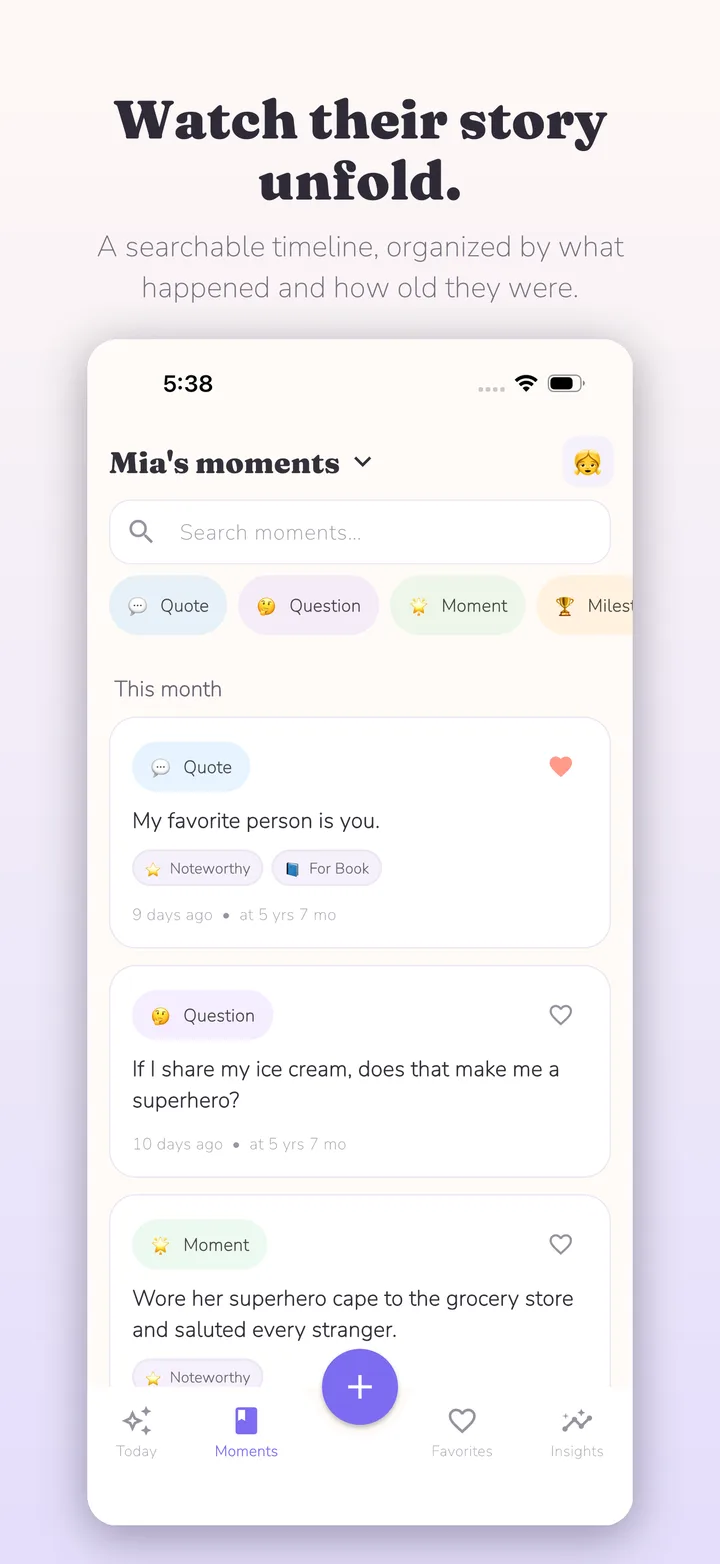
You do not need to document every day or create a perfect baby book. Even one short memory a week can become something extraordinary over ten or fifteen years. Kiddings is designed for these quotes, questions, moments, milestones, photos, videos, and voice memories, but the tool matters less than simply starting.
1. The funny things they say
Children say things that are hilarious precisely because they are not trying to be funny. Write their words down exactly as they said them—do not clean up the grammar or rewrite the sentence. The original wording is often what makes the memory special. “Why is the moon following our car? Does it want to come home with us?” may tell you more about who your child was at five than a hundred photographs.
2. The questions they ask
Children’s questions reveal how they understand the world. Some are practical, some philosophical, and some completely bizarre: Where does the sky end? Were you alive when dinosaurs were here? Who was your mummy when you were little? Does the moon sleep in the daytime? The questions themselves are memories.
3. Words they mispronounce
There is usually a word your child says incorrectly for months or years. Then one day they pronounce it correctly, and nobody announces that the old version is gone. Record “pasghetti” instead of spaghetti, “aminal” instead of animal, or whatever unique version your child invents. These tiny language mistakes can be surprisingly emotional to remember.
4. Their current favourite things
Every few months, record a simple list of their favourite food, toy, colour, song, book, cartoon, game, animal, person, and place. Children’s obsessions change incredibly quickly. A dinosaur phase that once seemed permanent may become almost impossible to remember a few years later.
5. Their bedtime routine
Bedtime is full of tiny rituals: the exact order of books, which stuffed animal must be in bed, how many hugs are required, whether the door stays slightly open, the song you sing, and the sentence they always say before sleeping. These ordinary routines often become some of the memories parents miss most.
6. What makes them laugh uncontrollably
Children go through phases where one ridiculous thing is the funniest thing in the world. Maybe it is a particular word, Dad pretending to fall over, or a joke that objectively stopped being funny after its fortieth repetition. Record it anyway.
7. What they are afraid of
Fears are part of childhood too: the dark, thunder, dogs, monsters, a cartoon character, or going upstairs alone. Sometimes those fears disappear so completely that it becomes hard to imagine your confident ten-year-old was once terrified of flushing the toilet.
8. What they think you do for work
Ask, “What does Mummy or Daddy do at work?” and record the answer exactly. Repeat the question every year. A five-year-old’s explanation of your job may bear very little resemblance to reality, which is precisely why you should save it.
9. What they want to be when they grow up
Astronaut, dinosaur scientist, YouTuber, police officer, ice-cream seller, doctor, princess, or dog—children’s ambitions can change every six months. Recording them creates a fascinating little history of how their imagination and identity develop.
10. Their friendships
Write down who their closest friends are, but do not stop at names. Ask why they like playing together. “Because she lets me decide which dragon we are” tells you far more than simply knowing who was in their class.
11. The games they invent
Children create entire worlds adults barely notice. The sofa becomes a boat, the hallway a racetrack, and three cushions a veterinary hospital. Write down these invented games—especially the rules, which are often extremely complicated and completely non-negotiable.
12. The little rituals between you
Maybe you share a secret handshake, silly nickname, special goodbye before school, Saturday pancake tradition, or a song in the car. These rituals can feel insignificant because they happen all the time. That is exactly why they are easy to forget.
13. Their current view of the world
Ask what makes someone a good person, what makes somebody old, why people get married, what being rich means, or what happens when people become adults. Their answers can be funny and unexpectedly thoughtful—wonderful snapshots of how their mind works at a particular age.
14. Things they are proud of
Ask, “What are you really good at?” They may name riding a bicycle, drawing dinosaurs, knowing every planet, helping a younger sibling, or being the fastest in their class. These little declarations reveal what mattered to them at that point in life.
15. The ordinary things they do every day
The most valuable memories later may be the most ordinary ones now: how they sit watching television, what they eat after school, how they carry their bag, where they leave their shoes, or the way they climb into your bed on Sunday mornings. Ordinary life changes quietly. Writing it down makes it visible again later.
16. Their relationship with siblings
If you have more than one child, record what they play, what they fight about, the names they call each other, how the older one comforts the younger one, and the completely unreasonable arguments. Sibling relationships evolve enormously, and these small moments preserve that shared history.
17. Their relationship with grandparents
Grandparents often have their own rituals, jokes, traditions, and special names. Maybe Grandpa always takes them for ice cream or Grandma tells a particular story. These relationships deserve to be documented because they become part of your child’s personal history.
18. Their voice
Photos capture faces and video captures movement, but voice is something parents often forget to preserve. Record how they say your name, their laugh, a favourite song, a story, difficult words, or a conversation between siblings. A ten-second recording can become an incredibly powerful memory years later. This is why Kiddings supports voice alongside text, photos, and video.
19. The stories behind the photos
Your camera roll stores the image, but usually not its story. You may remember where a photo in a red raincoat was taken, but will you remember that your child refused to walk around puddles because they believed worms would climb inside their boots? Whenever a photo has a story, add one or two sentences of context.
20. Who they are right now
Once or twice a year, write a short description of your child—not their height or school grade, but their personality. Notice what makes them curious, what they love and dislike, how they make friends, and what they insist is true. The point is not to predict who they will become. It is to preserve who they are today, because that version of them will never exist again.
How often should you record childhood memories?
You do not need to journal every day. Trying to record everything can turn memory keeping into another obligation. A much easier rule is to record something whenever you catch yourself thinking, “I want to remember this.”
That may happen three times in one week and then not again for a month. The goal is not completeness; it is preservation. One meaningful memory captured is better than twenty memories you meant to write down later.
A simple childhood memory routine
Once a week, ask yourself: What happened this week that I would like to remember in ten years? Write down one thing. It can be two sentences. After one year you will have roughly 50 memories; after ten years, 500. That is already an extraordinary record of a childhood.
What is the best way to save childhood memories?
A notebook works beautifully if you enjoy writing by hand. Google Docs and Apple Notes are simple and free. Day One works well as a general journal. If you want something designed specifically around childhood, Kiddings lets you save quotes, questions, stories, milestones, photos, videos, and voice memories in a timeline organised around your child.
Choose something you can use in seconds, because childhood memory keeping tends to fail when it feels like a project. Make the system easier than your excuses.
Do not just record the milestones
Birthdays, the first day of school, and graduation will be photographed. The moments that disappear are usually the ones nobody thinks to document: the ridiculous breakfast conversation, the made-up word, the bedtime question, the current obsession, the little voice, and the person your child is before they become the next version of themselves.
You do not need to record all 20 things on this list. Start with one. Write it down today. Years from now, you may be very glad you did.

Start with one moment today.
Kiddings is a private, ad-free storybook for your child’s words and little moments.