Memory Keeping
How to preserve your child's voice before it changes
Learn what to record, how to organize voice notes, and how to preserve your child's laugh, stories and changing voice without turning it into another project.
Photos are very good at remembering what your child looked like. They are less useful for remembering the tiny voice that once called an umbrella an “underbrella,” or the serious three-minute explanation of why the dog should be allowed to attend school.
Children's voices change quietly. There is no notification saying, This is the final week of that particular laugh. One day you simply realize the mispronunciation has disappeared and every yellow is now annoyingly correct.
You do not need hours of polished video to preserve it. A few short, ordinary voice recordings—saved with a date and one line of context—can hold far more personality than a camera roll full of nearly identical photographs.
The short answer
To preserve your child's voice before it changes:
- Record short, natural clips instead of staged performances.
- Save their stories, questions, jokes, songs, mispronunciations, and ordinary conversation.
- Add the date, their age, and a sentence explaining what was happening.
- Keep the recording in a place you can search and back up.
- Ask before recording or sharing, especially as your child gets older.
The goal is not to document every sound your child makes. Some sounds, particularly the recorder practice, may be allowed to pass peacefully into history.
Why voice is different from a photo
A photograph can show the missing front tooth. A voice recording remembers the whistle it added to every sentence.
Audio preserves things that are difficult to write down accurately:
- The rhythm of the way your child speaks
- A laugh that begins before the joke is finished
- The confidence of a completely incorrect explanation
- A favorite song with several original lyrics
- The names they give people, places, and household objects
- The pause before they answer a surprisingly big question
- The accent, expressions, and family phrases they absorb
You can write the words as well, and often should. But the recording carries the delivery: the certainty, hesitation, excitement, and comic timing that made the moment theirs.
This matters because childhood memory is not only visual. It has a soundscape—bedtime negotiations, stories from the back seat, whispered secrets, dramatic complaints about vegetables, and questions asked when you thought the day was finally over.
What should you record?
Start with the things that are already happening. You do not need to conduct a formal interview beneath a desk lamp.
Their current way of speaking
Record a few words or phrases your child says in a distinctive way. This might be a mispronunciation, a made-up word, a nickname, or the unusually formal phrase they picked up from a grandparent.
Ask them to use the word in a sentence rather than repeating it on command ten times. The natural version is usually the one you will want later.
A story in their own words
Ask what happened at school, how they built something, or what their drawing is about. Young children rarely believe a story requires a beginning, middle, or relationship with observable reality. That is part of the appeal.
A sixty-second explanation of a picture may preserve their imagination better than the picture alone.
Questions they genuinely ask
When your child asks something surprising, record the question and let the conversation continue. Do not rush to provide the polished adult answer. Their theory is often the part worth keeping.
“Where does the wind go when it stops?” is a memory. So is the detailed answer they give themselves before you have time to speak.
Songs, jokes, and performances
Save a verse of the song they are currently singing everywhere, one joke they are proud of, or a short piece from an invented show. Keep it brief. A child who senses an audience may produce a director's cut nobody requested.
Ordinary conversation
Milestones are easy to remember to record. Ordinary voices are easier to lose.
Capture thirty seconds at breakfast, during a walk, while building blocks, or when your child is describing the rules of a game they created five minutes ago. Years later, the background details—the clink of a spoon, a sibling interrupting, the way they call you from another room—may be as meaningful as the main event.
People they love
Record a short conversation with a grandparent, cousin, sibling, or family friend when everyone is comfortable with it. These clips preserve relationships as well as voices.
Do not make every gathering stop for documentation. One natural exchange is enough. The family can then return to debating whether anyone actually offered Grandpa a second cup of tea.
Use the 30-second rule
The easiest recording habit is deliberately small: aim for roughly thirty seconds.
That is long enough to capture a sentence, laugh, question, or piece of a story. It is short enough to record, label, replay, and keep. If the moment naturally runs longer, let it. The rule exists to remove pressure, not to cut off a child halfway through explaining the legal system of an imaginary kingdom.
Short clips also reduce the temptation to postpone recording until you can make something “proper.” Proper usually requires a quiet room, good lighting, a cooperative child, and several conditions not commonly found in the same house.
Press record when the moment is already happening.
Do not save the sound without the story
An audio file named Recording 147 is technically preserved. It is not particularly findable.
Add three details while the moment is still fresh:
- Date: When it happened
- Age: How old your child was
- Context: One sentence about where you were or what prompted it
For example:
17 September 2026 — age five
Explaining at breakfast why toast tastes better when cut into triangles. She considered rectangles “too serious.”
The note takes seconds, but it turns an unidentified sound file into a memory. It also gives future you a fighting chance of finding it without opening forty-seven recordings and listening for clues.
If you are saving the file in ordinary cloud storage, use a consistent filename such as:
2026-09-17-age-5-triangle-toast-story.m4a
It is not poetic. It works.
Keep the recording somewhere you can find again
There are several perfectly good ways to store children's voice recordings:
- Your phone's built-in voice recorder, with clear filenames
- A dated folder in your usual cloud storage
- A general journal that supports audio
- A private childhood journal that keeps the recording with the written story
The best choice is the one you already know how to use and will still understand six months from now.
Whatever you choose, avoid leaving the only copy on one phone. Follow the backup method you already trust for important family files. If you move recordings into folders, keep the original date in the filename or accompanying note.
You do not need an elaborate hierarchy. A folder for each year and child is usually enough. If your storage system needs its own instruction manual, somebody will eventually ignore the instruction manual. It may be you.
What if the moment is already in a video?
Keep the video. You do not need to convert every clip into a separate audio file.
Add a short note describing what is worth hearing and when it happens: At 0:18, she tells the made-up ending to the story. This makes the moment easier to retrieve later.
If you want a smaller voice-only keepsake, use a tool you already trust to create an audio copy while keeping the original video. Do not delete the source until you have confirmed the copy works and is backed up.
Often the simplest approach is enough: save the video beside a written quote or summary so you can find it by the words you remember.
Privacy changes as children grow
A toddler may be delighted by the record button. An older child may not want every song, confession, or half-finished thought preserved or sent to relatives.
Ask before recording when your child is old enough to understand. Tell them what you want to keep and who, if anyone, will hear it. If they say no, let the moment remain a moment.
Be especially careful with recordings involving fear, conflict, health, school problems, or something that could embarrass them later. Memory keeping is not surveillance with a nicer color palette.
The same rule applies to sharing. A recording can be precious to close family without needing to become public content. Use private sharing, choose the audience deliberately, and avoid forwarding a child's voice beyond the people they expect.
A simple monthly voice ritual
If spontaneous recording never occurs to you until three days later, use one gentle prompt each month.
Ask one question that fits your child's age:
- What made you laugh this week?
- What are you very good at right now?
- If you could change one rule at home, what would it be?
- What do grown-ups not understand?
- Tell me about the game you are playing lately.
Record the answer, add the date and context, then stop. Do not continue until the child begins giving answers in the tone of someone completing an annual performance review.
Twelve natural recordings over a year are enough to hear a voice, vocabulary, and personality change. Consistency helps, but missing a month does not create a gap that needs emergency repair.
How Kiddings keeps voice notes with the story
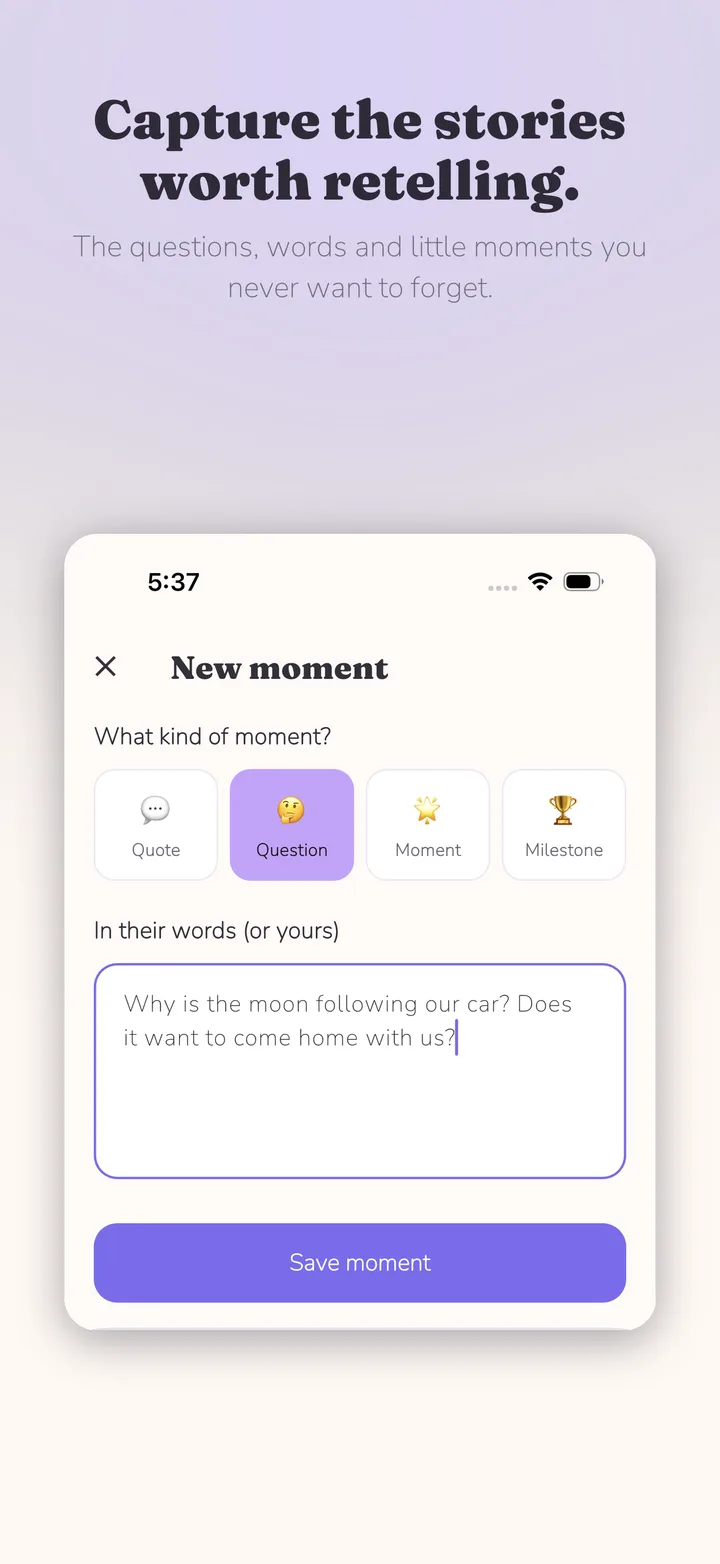
Kiddings is built for the parts of childhood that a camera roll often misses. You can save a quote, question, everyday moment, or milestone, then add text, photos, videos, and voice notes to the entry.
Each memory keeps the selected child's age at the time, and older memories can be backdated. Search, filters, favorites, and tags such as Noteworthy and For Book help you find the entry later instead of leaving it as Recording 147 forever.
Kiddings also supports multiple child profiles, a combined family timeline with per-child views, and invitations for selected family members. It has no public feed and is ad-free. Chosen written memories can later become a print-ready PDF keepsake; keep the original voice note in the private journal for the sound itself.
Kiddings is available on the App Store and Google Play.
For more ideas beyond audio, see 20 things to record about your child before they grow up. If words are what you keep forgetting, compare simple methods in Best app for recording things your kids say. And if you want a low-pressure system from the beginning, read How to start a childhood memory journal.
Frequently asked questions
What is the best way to record my child's voice?
Use the recorder already on your phone or a private journal that supports voice notes. Keep clips short, record natural conversation, and add the date, your child's age, and one sentence of context so the recording remains understandable later.
What should I ask my child in a voice recording?
Ask about something already important to them: a game, drawing, friend, recent joke, favorite place, or idea about how the world works. Specific questions usually produce more natural answers than “Tell me something about yourself.”
How long should a child's voice recording be?
Thirty seconds to two minutes is enough for most everyday memories. Let a good story continue naturally, but do not make length the goal. Short recordings are easier to capture, label, replay, and organize.
How should I organize recordings of my child?
Keep the date and child's age with every clip. Use consistent filenames or a journal that organizes entries by child and time. Add a few searchable words about the topic rather than relying on generic names such as New Recording.
Is it okay to share recordings of my child with family?
Share only with people you deliberately choose, and ask your child first when they are old enough to understand. Avoid sharing private, embarrassing, or sensitive conversations. A meaningful family recording does not need a public audience.
Record one ordinary sentence
Do not wait for a first word, a birthday speech, or an unusually cooperative performance.
Record one ordinary sentence this week. Add the date and the reason it made you smile. Then put the phone away and return to the conversation.
Years from now, the ordinary voice may be the extraordinary part.
Save one voice you never want to forget.
Kiddings keeps voice notes with the words, age and story that make them meaningful.