Memory Keeping
How to Make a School Memory Book for Your Child (One Spread Per Year)
Disclosure: This guide was written by Kiddings, an app for preserving childhood stories. The method works with a binder, scrapbook, document, photo-book service, or another memory system.
Make a school memory book with one spread per year: first- and last-day photos, quotes, schoolwork, a child’s choices, and practical privacy guidance.
A school memory book does not need every worksheet or themed dress-up day. A repeatable two-page spread can show who your child was, what changed, and what school felt like beyond the official photograph.
For each year, save:
- one first-day and one last-day photo;
- the child’s name, age, school year, and class details you are comfortable preserving;
- one Quote, one Question, one ordinary Moment, and one Milestone;
- one piece of schoolwork, art, or handwriting;
- one child-chosen memory;
- one short parent or caregiver note.
That gives you a school-years book that can grow from preschool through elementary school without requiring a new craft qualification every June.
Choose the book’s boundaries
Decide what one “school year” means in your family. It might be:
- preschool or nursery year;
- kindergarten or reception;
- a numbered grade or year group;
- homeschool year;
- a period between two first days, even after a move or school change.
Print the exact dates when you know them. “August 2026–June 2027” will travel better through time than “This Year.” If the child changed schools or classes, note both rather than forcing the year into one tidy label.
You can separate preschool and elementary years or keep one running book. Before choosing a bound format, count the years and decide on two pages, four pages, or a pocket per year. A binder expands easily; a printed book is more compact.
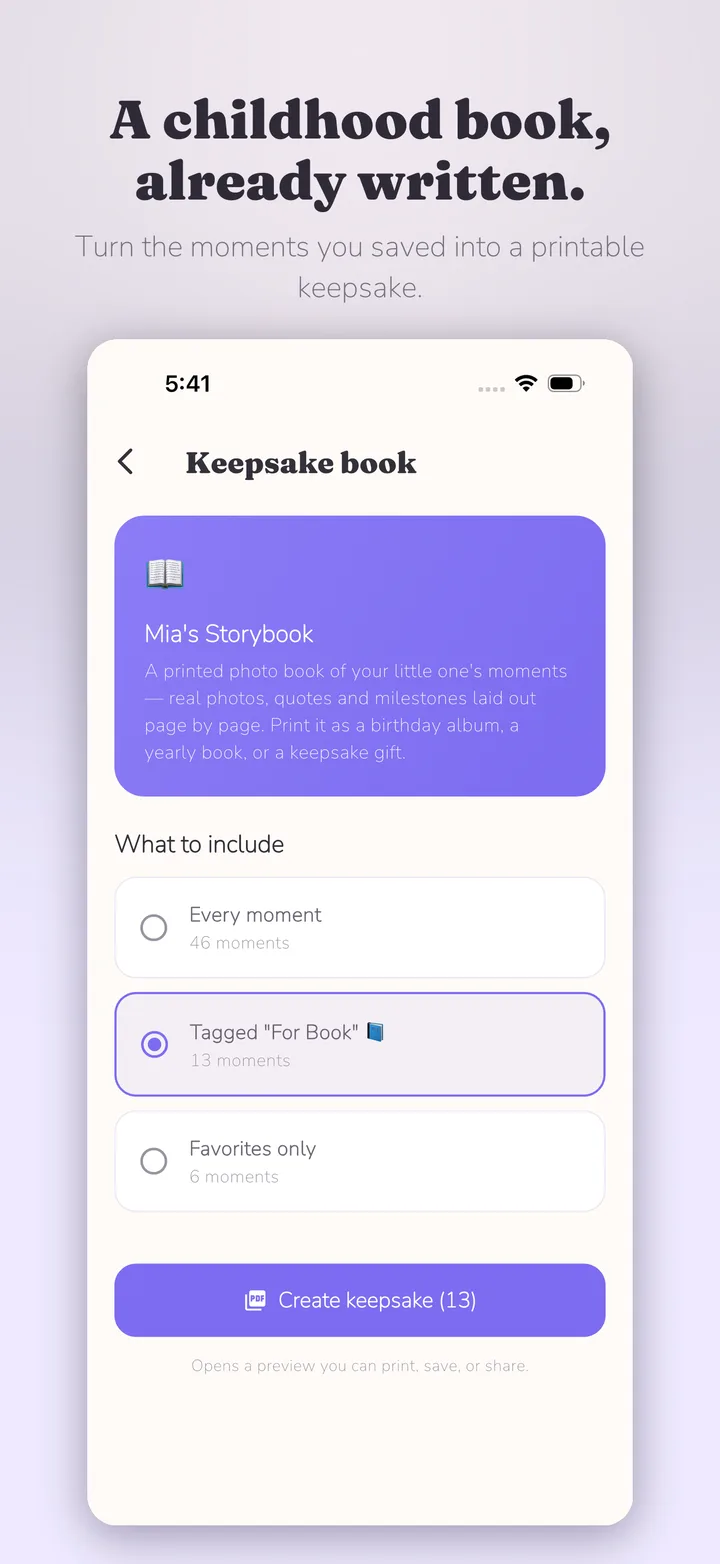
Kiddings can help parents collect the stories before book-making day. Quotes, Questions, Moments, and Milestones are tied to a child and age; search, filters, favorites, and tags such as School or For Book can help retrieve candidates later. Kiddings does not automatically create custom school-year spreads.
Use the same two-page structure every year
A consistent structure makes the multi-year book easier to maintain and more interesting to compare.
Left page: the visible year
Include:
- first-day and last-day photos;
- school year and date range;
- the child’s age at the beginning and end;
- school or learning setting, if appropriate to keep;
- one sample of handwriting, drawing, or work;
- one or two interests that dominated the year.
Right page: the remembered year
Include:
- one exact Quote;
- one memorable Question;
- one ordinary school-day Moment;
- one meaningful Milestone or change;
- the child’s own choice or sentence;
- a short caregiver note.
This balance stops the book becoming either a stack of paperwork or a sequence of portraits with increasingly expensive shoes.
A completed sample spread
Everything in this example is fictional. The child, teacher, schoolwork, quotations, and events are illustrations—not a real family or Kiddings customer.
Left page
- Child: Samira
- School year: Year 2, September 2026–July 2027
- Age: 6 years 10 months to 7 years 8 months
- First-day caption: Samira chose the green jumper because it had “serious pockets.” She carried a new pencil case and asked three times whether lunch would happen before science.
- Last-day caption: Same front step, shorter trousers, no pencil case. She was carrying a paper model of a lighthouse and a library book she had accidentally kept for six weeks.
- Artifact: A scanned page from her handwritten story, The Lighthouse That Hated Fog.
- This year’s interests: Lighthouses, codes, and making signs for doors that did not require signs.
Right page
- Quote: “Group work means everyone has a pencil but only one person knows the plan.”
- Question: “If the Romans had roads, why didn’t they invent buses?”
- Ordinary moment: On Wednesday mornings, Samira and her friend met beside the same playground drain to compare objects found on the walk to school.
- Milestone: She began walking into class without asking Dad to wait until the door closed.
- Samira’s choice: The rainy field trip because “we were allowed to complain and learn at the same time.”
- Caregiver note: You started the year wanting to know every detail before entering a room. By summer, you were often the person explaining the room to somebody else.
Two photographs and one artifact preserve language, routine, friendship, change, and the child’s priorities.
Pair first-day and last-day photos with captions
The photos become more useful when the caption records what the image cannot.
On the first day, note:
- age and date;
- what the child chose to wear or carry;
- what they expected, hoped, or wondered;
- one detail about the morning;
- their exact words, if known.
On the last day, note:
- what changed physically or practically;
- what now felt familiar;
- what they were carrying home;
- what they would miss or were ready to leave;
- what surprised them about the year.
Avoid turning the pair into a visual test of growth, confidence, or achievement. The purpose is comparison with context, not a before-and-after advertisement for schooling.
If you missed either photograph, use another dated image from early or late in the year. Label it honestly. The book does not become invalid because nobody posed beside the front door on the required morning.
Choose one school artifact, not the entire backpack
Good candidates include:
- one handwritten page;
- a drawing or diagram with a story behind it;
- a short piece of writing in the child’s own voice;
- a project photograph;
- a certificate or program that genuinely mattered to the child;
- a teacher note you have permission to keep;
- a page that shows a changed interest, skill, or way of thinking.
Choose for story value rather than neatness. The crossed-out page may reveal more about the year than the polished final copy.
For a physical book, keep the original in a pocket only when its material and size suit the format. Otherwise photograph or scan it, preserve the date and context, and store or release the original separately. For a fuller sorting method, see how to preserve kids’ artwork without keeping every piece.
Do not cut up a unique report, signed document, irreplaceable drawing, or school photograph simply to make it fit. Use a copy.
Report cards and teacher comments are optional
A school memory book is not required to become a permanent academic file.
If a report contains a sentence that captures the child’s year, you might quote or paraphrase that small part with permission and context. You can also summarize: “This was the year reading aloud stopped feeling intimidating,” rather than reproducing grades, attendance, behavior notes, and staff details.
Leave out sensitive educational, behavioral, disability, medical, disciplinary, or family information unless there is a clear, respectful reason to preserve it and the child’s privacy has been considered. A keepsake may be shared widely years later. Information collected for school administration does not automatically belong in it.
Do not include another child’s report, full name, contact information, or private circumstances.
Class photos need a privacy decision
A class photo can anchor the year, but it also shows other children. A copy you keep at home and a book you send to relatives can have different audiences.
Check the school or photographer’s sharing terms before copying or distributing a class photo. If you are unsure about sharing it, choose a separate photo of your child for the book and keep the class photo with your private papers.
Do not add a full list of classmates’ names, school addresses, classroom schedules, or identifying details merely because the layout has space. The future reader can understand the year without receiving a directory.
Record the tiny school stories
Official milestones are easy to find. The school-year texture often lives in smaller entries:
- the breakfast eaten on club day;
- the object kept in a pocket for luck;
- the repeated bus-stop question;
- the friend met at the same gate;
- the teacher phrase that entered family vocabulary;
- the book repeatedly renewed;
- the complaint made every Monday and forgotten by Monday afternoon;
- the after-school decompression routine;
- the route taken through the playground;
- the item permanently missing from the pencil case.
Capture one scene in three or four sentences:
Age + date or period + setting + what happened + exact words or telling detail
For example:
At age five, during the spring term, Eli began checking the classroom weather chart before saying hello. One foggy morning he announced, “The weather is undecided, so I am also undecided,” and kept his coat on through registration.
Eli and this scene are fictional.
Ask the child what belongs
GreatSchools recommends using questions to gather the child’s thoughts and learn what they want included. Keep the conversation brief:
- What is one thing you want this book to remember?
- Which picture feels most like your year?
- What was an ordinary part of school that is different now?
- Who helped make the year easier or funnier?
- What did adults think was important that you did not?
- Is there anything here you want left private?
A preschooler might choose artwork or dictate a sentence. An older child may edit captions, choose an artifact, or prefer the science-fair snack table to the official photograph. Their choice is information, not a design problem.
Do not turn the process into homework. One answer is enough.
A short entry template
Use this when you find a school memory during the year:
- Child and age:
- Date or school period:
- Type: Quote, Question, Moment, or Milestone
- Setting and people:
- What happened:
- Exact words or honest paraphrase:
- Why this belongs to this school year:
- Photo or artifact, if useful:
- Private, family-tagged, or book candidate:
This creates enough context to select the entry later without writing the whole spread at pickup time.
Build a multi-year book without falling behind
Create the same empty spread at the start of each school year. Save possible materials into one labeled folder—physical or digital—and make final choices once, near the end.
If several years are missing, do not rebuild every week of school. For each year, find:
- one early and one late photograph;
- one piece of work or handwriting;
- one exact or honestly paraphrased line;
- one ordinary routine;
- one relationship or interest;
- one change;
- one short caregiver note.
Use calendars, messages, photographs, school dates, and relatives as prompts. Mark uncertain dates. A shorter truthful spread is better than a detailed reconstruction that quietly invents chronology.
More than one child
Use the same basic structure for each child, but do not force identical content. One child’s year may center on a friendship; another’s on an interest or transition.
Keep each child’s school artifacts and candidate stories in a clearly named folder. Shared school events can appear in both books only when each caption follows that child’s perspective; otherwise place the story with the child it mainly concerns.
For a broader system that avoids duplicate work, see how to organize childhood memories for multiple children.
Using Kiddings for school memories
Parents can record school-related Quotes, Questions, Moments, and Milestones in Kiddings with the child, date, and exact age. Entries can be backdated and later found through timelines, search, filters, favorites, and tags. Photos, video, and voice can support the story.
Parents can invite selected family members as viewers or contributors. Family members see only entries tagged for family, not the parent’s whole private journal. Use that option only for school stories appropriate to share.
Selected memories can become a print-ready PDF. Parents choose an online printer or neighborhood print shop; Kiddings does not create custom school-year page layouts and does not print, order, bind, or ship the book. Cost and quality vary by printer, location, format, paper, binding, quantity, and shipping; independent printing is not guaranteed to be cheaper.
A PDF page cannot make video or voice playable on paper and does not replace original media or school artifacts.
Frequently asked questions
What age should I start a school memory book?
Start with the first year that matters to your family: childcare, preschool, kindergarten, reception, homeschool, or later. You can also begin now and backfill earlier years selectively.
How many pages should each school year get?
Two pages are enough for a consistent multi-year book. Use more when the physical format allows it and the year has material worth keeping.
Should I include every school report and certificate?
No. Include only what adds meaningful context and respects the child’s privacy. Keep formal records separately if they need to be retained for administrative reasons.
Can I include classmates and teachers?
Mention people when they belong to the story, but minimize identifying details and do not reproduce or distribute class images, private comments, or contact information without appropriate permission.
What if my child dislikes school?
Do not force a cheerful summary. Preserve a few specific, dignified truths: an ordinary routine, a person who helped, something the child cared about outside lessons, a change, and their own words. The book does not need to grade the year.
One spread, one real school year
The useful school memory is rarely the complete pile. It is the first-day pocket inspection, the question about Romans and buses, the library book that returned late, the friend by the drain, the project carried home in the rain, and the last-day sentence the official photograph could not hear.
Keep one spread per year. Make it specific. Let the child disagree with your choice. Then close the book before the loose worksheets establish their own school system in the cupboard.

Start with one moment today.
Kiddings is a private, ad-free storybook for your child’s words and little moments.