Memory Keeping
How to Make a Childhood Memory Box: What to Keep and How to Organize It
Kiddings created this guide. The method works with any box and any way of recording family stories.
All child quotes and family examples are fictional illustrations.
Make a childhood memory box with a clear space limit, meaningful keepsakes, story labels, a simple index, and an annual review. Learn what to photograph instead.
A childhood memory box works best when it has a firm physical limit and a simple rule: keep the object when the object itself matters; keep a photograph and the story when it does not.
Choose one sensibly sized box for each child, or one family box with clearly labeled sections. Give every object a short note with the child’s name, date or approximate date, age, context, and the reason you kept it. Maintain a one-page index, then review the box once a year. That is enough structure to turn a pile of mysterious small things into a collection someone can actually understand later.
What a childhood memory box is—and what it is not
A childhood memory box is a physical collection of meaningful objects from a child’s life. It might hold a first pair of shoes, a handwritten note, a theatre ticket, a tiny toy that went everywhere for six months, or the paper crown from a birthday breakfast.
It is not the place where every school worksheet goes to await a decision in 2043.
The difference is selection. A useful memory box contains objects with stories attached. A catch-all box contains objects plus future admin.
That makes the container important. Its size is not an inconvenience to solve with a growing line of containers. The limit helps you choose. When the box fills up, review it instead of automatically expanding it.
A physical box does a different job from a childhood journal. The box keeps an object’s texture, shape, wear, and scale. A journal keeps what the object cannot explain: what happened, what your child said, and why it mattered.
Start with one box and a clear scope
Use one box for each child, one family box with labeled sections, or separate boxes for early childhood and school years. Shared traditions and trips can have a family box.
Choose the version that fits the space you actually have. There is no prize for owning archival furniture.
If you have several children, separate boxes are often easier because ownership is clear. Shared objects can go in a family box, or you can choose one home for the object and record the full story for every child involved. The guide to organizing childhood memories for multiple children has a broader system for keeping family stories connected without duplicating all the work.
Place the box somewhere dry, clean, and away from obvious sources of moisture, food, pests, or direct sunlight. For an unusually delicate, valuable, or historically important object, ask a suitable preservation professional rather than relying on general household advice.
Add plain cards for story labels, a pen or pencil, and one index sheet kept inside the box.
You do not need matching stationery. The child will not reject their history because the labels use two different shades of white.
What should you put in a childhood memory box?
Keep objects that carry something a photograph cannot fully preserve: their size, texture, wear, shape, or role in a particular story.
1. A small object that was genuinely used
Think of a first pair of shoes, a well-worn sun hat, a favorite costume accessory, or the tiny backpack your child insisted on wearing even when it contained only one smooth stone.
2. A ticket, program, card, or badge with context
A ticket by itself may say little. A ticket with a note—“First live basketball game, age seven; spent the entire second quarter asking where the players keep their snacks”—becomes a scene.
Keep a representative item from the day, not every receipt generated by it.
3. A small toy or object that represents a phase
Perhaps it is the toy train carried to preschool every morning, the plastic dinosaur appointed family doctor, or the key ring collected on a trip. Choose one object that stands for the phase rather than the complete population of the toy box.
4. A handwritten note or early piece of writing
A short note can preserve handwriting, spelling, and voice together. Add the date, age, and enough context to make it intelligible. “SORRY FOR THE HAM” will raise more questions in twenty years unless you explain what happened to the lunch.
5. An object from a family ritual
A homemade place card, a small holiday decoration, a recipe card used together, or a ribbon from an annual event can represent repetition as well as a single day. Note the ritual and your child’s part in it.
6. One item from a meaningful first or change
This could be a hospital bracelet, a name tag from a new club, a first library card that is no longer active, or a token from the first independent bus journey. Keep only what you are comfortable storing, and be thoughtful about personal information visible on documents or labels.
What should you photograph instead?
Some things are meaningful but poor candidates for permanent storage. Photograph the object and record its story when it is:
- too large for the box;
- temporary or perishable;
- one of many similar items;
- still needed for everyday use;
- borrowed or owned by someone else;
- difficult to store without damage; or
- less meaningful as an object than as evidence of a funny phase.
A cardboard spaceship may have occupied the living room for three heroic weeks. You do not have to preserve it at full scale to prove it existed.
Take one clear photograph and, if useful, a close-up of the important detail. Then add what photographs routinely miss: your child’s explanation.
For example:
Imaginary example: “The silver circles are emergency moon biscuits,” said Nia, age five, about the control panel drawn inside her cardboard spaceship.
That sentence is often more distinctive than twelve near-identical photographs of cardboard.
If children’s drawings and paintings are the main challenge, use the more specific guide to preserving kids’ artwork without keeping every piece.
Label the story, not just the object
An unlabeled keepsake asks its future reader to perform archaeology. Make the label while the context is still ordinary knowledge.
Use this template:
- Object:
- Child:
- Date or approximate date:
- Age:
- Where it came from:
- What happened:
- Child’s exact words, or an honest paraphrase:
- Why we kept it:
- Related photo or digital entry:
A useful label might be only four lines:
Imaginary example
Red plastic key, carried by Leo for most of April 2026, age three. He used it to “open the morning” before leaving the house. Kept because it turned every front door into a ten-minute ceremony.
The phrase “open the morning” is the center of the memory. The red key gives it a physical handle.
When you do not remember the exact date, write the month, season, school year, or approximate age. An honest approximation is better than false precision.
Keep a simple index inside the box
The index tells you what is in the box without requiring a full excavation.
A handwritten sheet is enough. Use columns for:
| Item | Short description | Date or age | Child | Related story |
|---|---|---|---|---|
| 01 | Red plastic key | April 2026, age 3 | Leo | “Open the morning” |
| 02 | First theatre ticket | November 2027, age 5 | Leo | Asked whether actors sleep backstage |
| 03 | Blue swim badge | Summer 2029, age 7 | Leo | Jumped in after three refusals and one snack |
The examples above are fictional.
Give each object a number on its label or sleeve, then use the same number in the index. If you keep a related digital story, add the title, date, or tag that will help you find it.
Its purpose is recognition, not enterprise asset management.
Use a four-decision sorting method
When a pile has already formed, pick up one item at a time and make one of four decisions:
Keep the original
Choose this when the physical object contributes something essential and it earns the limited space.
Photograph it and keep the story
Choose this when the memory matters more than the material object. Take the photograph, write the context, and then decide what to do with the original.
Pass it on
Some items can return to everyday life, move to another family member, or be given away once their story is recorded. If the object matters to your child, include them in that decision.
Let it go
Not every object needs a second career as a keepsake. Recycle, discard, or otherwise handle it in the ordinary appropriate way once you have made a deliberate choice.
If you cannot decide, create a small “review later” envelope. Date it. At the next annual review, anything still inside must compete for space again. This is a pause, not witness protection for clutter.
Separate the object from the searchable story
Let the box hold the object. Let the digital entry hold the photograph, date, age, searchable words, and fuller story.
Kiddings is built around four kinds of childhood stories—Quotes, Questions, Moments, and Milestones—with photos, video, and voice notes supporting the entry. A parent could photograph a memory-box object, record the child’s exact words and context, backdate the entry if needed, and add a manual tag such as “Memory Box.” Search, filters, favorites, and tags can then help find the story later.
This does not make Kiddings a physical inventory system, and it does not track the object’s location automatically. Write the box item number in the entry yourself, and put the entry date or title on the physical label. That small cross-reference is enough.
The four story types can help you notice why an object matters:
- Quote: the exact sentence attached to it;
- Question: what your child wondered at the time;
- Moment: the scene in which it mattered; or
- Milestone: a meaningful first, change, or accomplishment represented by it.
Review the box once a year
An annual review keeps the box selective and fixes missing context before it disappears.
Choose a predictable time: the child’s birthday month, the end of the school year, or a quiet week after the holidays. Then:
- Read the index.
- Add labels to any mystery items.
- Remove objects that no longer earn their space.
- Add a few strong items from the year.
- Update related photographs or digital stories.
- Ask the child whether there is something they want to keep, release, or keep private.
The review need not become a ceremony. Twenty focused minutes can beat an ambitious afternoon that ends with every object on the floor and nobody speaking.
As children get older, let them take more control. They may value a small ordinary object that an adult would overlook. They may also want to remove something that feels personal or embarrassing. A memory collection should not become a permanent case against its subject.
Sharing the story without sharing the whole box
Sometimes a relative knows part of an object’s story. Ask for the missing detail if that feels appropriate.
In Kiddings, selected family members can be invited as viewers or contributors. They see only entries tagged for family, not the whole private journal. That makes it possible to share one memory-box story without opening every other entry.
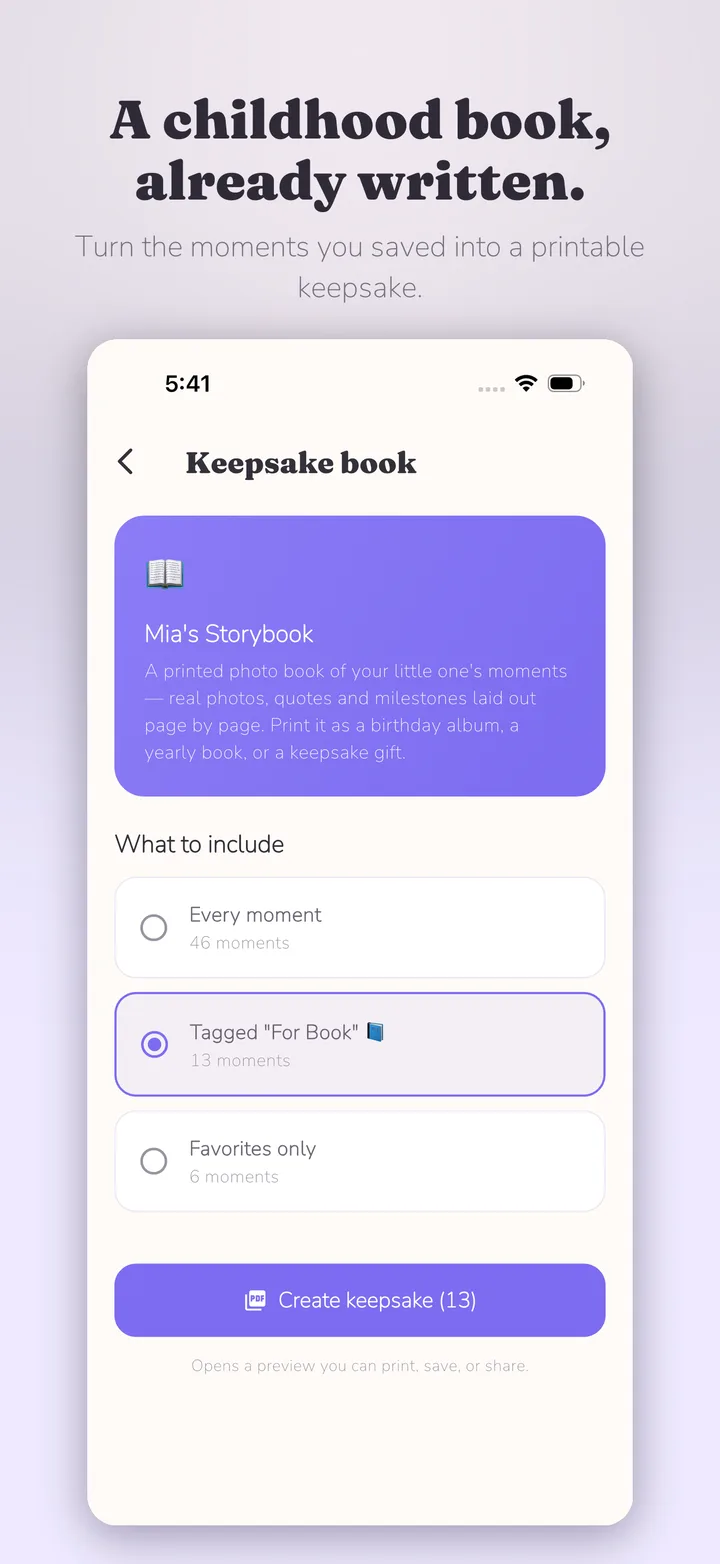
Later, selected memories can be exported as a print-ready PDF. You can take that file to an online printer or a neighborhood print shop, choosing the printer, paper, format, quantity, and timing yourself. Kiddings does not order, print, bind, or ship the book. Price and quality vary by printer, region, format, paper, binding, and shipping, so independent printing is not guaranteed to cost less.
Frequently asked questions
How big should a childhood memory box be?
Choose one that fits your storage and treat its capacity as a real limit. A huge box invites postponement; a tiny one can make every decision unnecessarily severe.
How many items should I keep each year?
There is no correct number. Let capacity and story value decide. Three distinctive objects can say more than thirty nearly identical ones.
What should I do when the box is full?
Review before expanding. Remove duplicates, photograph bulky items, and ask whether each object adds something beyond its recorded story. If it does, start a clearly defined second box instead of an unlabeled overflow box.
Can I put photographs in the memory box?
Yes, but include dates, names, and context. If photos already live in a reliable digital system, reserve the box for material things that cannot be fully experienced on a screen.
What if my child wants to keep something I would discard?
Ask what it means to them. If it fits, give their choice real weight. If it does not, photograph it, record their explanation, and agree on another home or a later review date. The box is about their childhood, not an adult’s audition for most efficient cupboard.
A small box, with the stories left in
A childhood memory box does not need to hold a complete childhood. It needs to hold a thoughtful selection.
Choose one container. Keep objects whose physical presence adds something. Photograph the rest. Label the child, date, age, context, and words. Maintain a simple index. Review once a year.
Most importantly, do not leave the object to explain itself. A red key is just a red key until someone records that it once opened the morning.

Start with one moment today.
Kiddings is a private, ad-free storybook for your child’s words and little moments.