Memory Keeping
What to Write in a Child’s Milestone Journal After the Baby Years
Disclosure: This guide was written by Kiddings, an app for preserving childhood stories. The ideas work in a paper journal, document, notes app, or another memory system.
Learn what to write in a child’s milestone journal after toddlerhood, with practical ideas for independence, friendships, interests, and everyday change.
After the baby years, milestones become less obvious and more interesting.
There may no longer be a printed page asking for the date of a first tooth or first step. Instead, change appears in ordinary life: the first time your child orders for themselves, repairs a friendship, packs for an overnight stay, reads instructions to build something, or walks into a familiar place without reaching for your hand.
A milestone journal can keep those shifts without becoming a developmental checklist. Record changes that matter in your child’s life, at the time they happen, without treating them as proof that the child is early, late, advanced, or behind.
The shortest useful entry is:
What changed + the scene that revealed it + the child’s words + age and date
For example:
At age 7 years 3 months, Noor packed her own bag for a night at Auntie’s. She forgot pajamas but remembered three books and said, “Sleeping is not the main activity.” It was the first overnight visit she prepared for herself.
Noor and every named child, quotation, and scene in this article are fictional. They are illustrations, not customer stories.
That is enough for a milestone entry. No certificate is required.
What counts as a milestone after toddlerhood?
A milestone is a meaningful first, change, growing ability, transition, or last appearance of something familiar. It can happen at school, at home, with friends, in a hobby, or during an unremarkable Tuesday.
Some are clearly marked: starting school, losing a tooth, performing onstage, traveling without a parent, or completing a long project. Others are visible only to people who know the child well: asking for help before frustration takes over, making a friend in a new setting, preparing a snack independently, or quietly retiring a toy that once went everywhere.
A milestone journal is not an expected-age checklist. Its job is to preserve what change looked and sounded like in one child’s actual life.
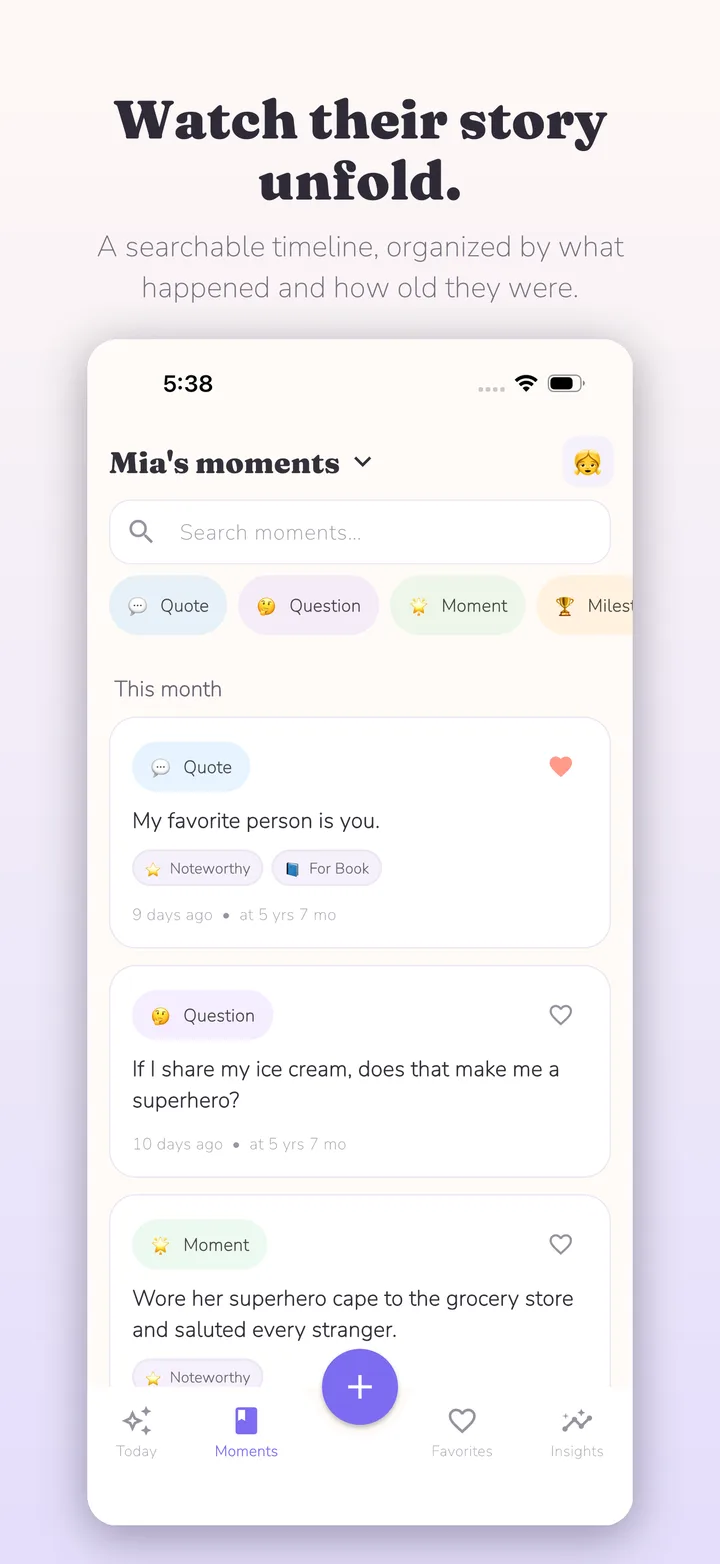
Kiddings separates Milestones from Quotes, Questions, and Moments. That can help because not every charming event needs to be promoted to milestone status. A new skill or transition can be the Milestone; the explanation they gave, the question they asked, and the ordinary scene around it can remain connected parts of the story.
Use context instead of a checklist
“First time riding a bike” is a label. The story needs more:
- Where did it happen?
- Who was there?
- What had the child tried before?
- What changed on this attempt?
- What did they say or do immediately afterward?
- What detail would make the scene recognizable years later?
You might write:
At age eight, Theo rode from the park gate to the bench without a hand on the seat. Dad ran behind him for half the path before noticing he was no longer needed. Theo stopped, looked back, and shouted, “Why are you still running?”
Theo and this scene are fictional.
The date and achievement matter. The unnecessary running is the part the family may actually retell.
Avoid turning an entry into a comparison. “She finally did this, months after everyone else” makes another child’s timeline the frame for her story. Write what she attempted, what changed, and what the moment meant inside her own life.
Independence milestones worth noticing
Independence after the baby years is rarely one dramatic separation. It accumulates through small acts of managing, choosing, remembering, and recovering.
Possible entries include:
- choosing clothes for a particular purpose and explaining the choice;
- packing a school, sports, travel, or overnight bag;
- ordering food or asking a shop assistant a question;
- making a simple snack or part of a meal;
- noticing a mistake and deciding how to fix it;
Do not write “independent now” as if the change applies everywhere and forever. Children can handle the bakery counter confidently and still need a parent to locate the shoes directly in front of them. Describe the specific situation.
A useful prompt is:
What did my child manage today that I would have managed for them not long ago?
Friendship and relationship milestones
Relationships produce milestones that baby books rarely anticipate. These are not awards for being socially perfect. They are changes in how a child joins, responds, repairs, includes, trusts, or understands another person.
You might record:
- the first friend they arranged to see outside the usual setting;
- joining a group, club, team, cast, or shared project;
- welcoming a new child or asking to be included;
- resolving a disagreement in a new way;
- apologizing in their own words;
Protect the other child’s privacy. Use a first name or general description only when appropriate, and avoid preserving somebody else’s difficult moment in unnecessary detail. Center what your child said or did rather than diagnosing the friendship.
For example:
During the first month at the new school, Ava asked a classmate if she wanted to draw together at lunch. Later Ava said, “I thought she looked like she needed a plan.” It was the first new-school friendship she initiated herself.
Ava and this scene are fictional.
Interests, creativity, and projects
A new interest can change the rhythm of family life. Suddenly every walk is about birds, every cardboard box is structural material, or dinner includes a briefing on train coupling systems.
Record the point when an interest became recognizably theirs:
- the first project they planned across several days;
- a subject they began researching without an assignment;
- the first book, song, game, craft, or sport they chose to practice repeatedly;
- making something for a real audience or purpose;
- finishing a model, story, performance, collection, or repair that required persistence;
The milestone is not necessarily being good at the activity. It may be committing to it, finding their own taste, or choosing to stop thoughtfully. Preserve process without writing a performance review.
Try:
What did my child care enough about to continue when nobody assigned it?
Add a photo of the project if useful, but include the title, child’s explanation, age, and what was different this time. A photograph of a cardboard machine proves that cardboard existed. The caption explains that it sorted invisible mail for dragons.
Everyday skills and family contribution
Some milestones make a household work differently. They deserve a place even when nobody takes a photograph.
Consider recording:
- learning a family recipe or preparing one part of a meal;
- using a household tool safely with supervision appropriate to the situation;
- taking consistent responsibility for a pet, plant, laundry step, table task, or shared space;
- reading and following instructions for a real task;
- budgeting saved money for something they chose;
Avoid turning contribution into a statement about virtue. “Loaded the dishwasher without being asked on October 12” is a scene. “Has become responsible” is a conclusion that next Tuesday may dispute.
Capture the child’s words, especially when their understanding of the task is part of the memory:
Jonah made scrambled eggs for the family at age nine. He announced, “The secret is medium confidence,” then asked where the shells should go.
Jonah and the quotation are fictional.
Communication, judgment, and self-advocacy
Older-child milestones often happen in conversation rather than movement. They can be easy to miss because the child does not announce that they have just handled something differently.
Possible entries include:
- asking a question directly instead of relying on a parent to ask;
- explaining a need, preference, or boundary clearly;
- telling an adult about a problem before it grew;
- changing their mind after hearing new information;
- disagreeing respectfully with a family member;
Keep sensitive details private. A child’s journal should not become a hidden case file of arguments, school issues, or vulnerabilities. Ask an older child before preserving or sharing personal material, and accept that some milestones belong to them rather than the family archive.
Transitions and brave first attempts
Transitions are milestones even when they are gradual or untidy.
You might record the first day in a new class, school, home, neighborhood, team, performance group, or family arrangement. You can also save the first time the child:
- attended an event without a parent nearby;
- stayed overnight away from home by choice;
- traveled a familiar route with new responsibility;
- spoke or performed before an audience;
- tried again after an earlier attempt went badly;
Do not force a triumphant ending. “She went in even though she felt nervous, stayed for twenty minutes, and decided to try again next week” can be the honest milestone. Progress does not need a film score.
“Last times” and quiet endings
Some milestones are visible only afterward: the last bedtime story requested every night, the final use of a childhood nickname, the toy that stopped coming on trips, or the day a hand was no longer offered at a crossing.
You may not know the exact last date. Write an approximate season or age and explain when you noticed the change:
Sometime during the spring at age ten, Mina stopped bringing Fox to sleepovers. I noticed when we packed for her cousin’s house and the bag had room for a second pair of socks.
Mina and this scene are fictional.
Treat endings gently. Do not tell a child they are “too old” for the thing or manufacture a farewell ceremony they did not want. The journal can note change without declaring one stage superior to another.
A milestone-entry template
Use this template for a full entry:
- Milestone or change: What happened for the first time, became newly possible, or ended?
- Date: Exact or approximate.
- Child’s age: Use the level of precision you naturally keep.
- Setting: Where were they, and who was present?
- Before: What had the child done, needed, or avoided previously?
- The revealing scene: What made you notice the change?
- Child’s words: Exact quotation if known; honest paraphrase otherwise.
- Supporting detail: One object, sound, mistake, reaction, or ordinary detail.
- Why it mattered here: What changed in the child’s or family’s real life?
The entry can still be two sentences. The fields are prompts, not compulsory paperwork.
A short example
Milestone: First time resolving a schedule problem with a teacher herself. Age: 11 years 1 month. Scene: Elena noticed two activities overlapped, explained the conflict after class, and asked what she should prioritize. In the car she said, “I was worried, but it was a two-minute worry.” Previously she would have asked Dad to send the message.
Elena and this scene are fictional.
This preserves independence, language, and context without claiming Elena has permanently mastered every difficult conversation.
How often should you add milestones?
Write when change becomes visible, not on a schedule designed to create enough content. Some months contain several transitions. Others contain ordinary life, which can be recorded as Quotes, Questions, or Moments instead.
If you want a light routine, try one of these:
- review the month and save one change you noticed;
- add a Milestone when a new responsibility alters family routine;
- look back at the end of a school term or season;
- mark possible milestones in a quick note, then add context during a weekly review;
- ask, “What can my child do, choose, explain, or manage differently from six months ago?”
Missing a date does not erase the memory. Backdate with the best honest estimate: month, season, school term, holiday, or approximate age.
For a routine that does not require daily writing, see how to keep a parenting journal when you have no time.
Let the child add their version
When appropriate, ask what the milestone felt like from their side:
- “When did you realize you could do it?”
- “What part was harder than it looked?”
- “What do you want to remember about that day?”
- “Does my version miss anything?”
Their answer may change the story. The parent remembers the first solo bus trip; the child remembers choosing the wrong seat and discovering the stop button was louder than expected. Keep both perspectives when both belong.
Do not quiz the child or require a reflection. A brief answer, correction, drawing, photo, or voice note can support the entry. Silence is also an answer.
For more on revisiting stories together without turning them into a test, read how to share childhood memories through family storytelling.
Using Kiddings after the baby years
Kiddings supports Quotes, Questions, Moments, and Milestones throughout childhood, organized by child, date, and exact age. Parents can backdate older entries and later use timelines, search, filters, favorites, and tags to find and curate them. Text, photos, video, and voice can support the story rather than replace it.
Parents can invite selected family members as viewers or contributors. Family members see only entries tagged for family, not the parent’s whole private journal.
Selected memories can become a print-ready PDF. Parents choose an online printer or neighborhood print shop; Kiddings does not print, order, or ship the book. Cost and quality vary by printer, location, format, paper, binding, quantity, and shipping, so choosing a printer is not guaranteed to cost less.
Kiddings is one way to keep a milestone journal. A notebook or document works too. The best system is the one that lets you preserve the scene while you still remember why the forgotten pajamas and three carefully selected books mattered.
Frequently asked questions
Is a milestone journal the same as a developmental tracker?
No. It records meaningful family changes and stories rather than expected-age benchmarks.
What if my child reaches a milestone later than another child?
Leave comparison out. Record what changed, the child’s own path, their words, and the context.
Do milestones have to be firsts?
No. A milestone can be growing independence, a changed relationship, a completed project, a new responsibility, a transition, or the end of a familiar stage.
Should I include school awards and grades?
You can when they matter to the child, but record the surrounding story rather than only the result. What did they work on, say, notice, or choose? Avoid making achievement the only kind of change worth keeping.
How do I record a milestone when I missed the exact date?
Use the month, season, school term, event, or approximate age you genuinely remember. Label estimates honestly. Useful context is better than invented precision.
Keep the change, not just the label
After the baby years, there is no universal page telling you what belongs next. That is useful. You can stop collecting milestones because a book expects them and start recording the changes that reveal who your child is becoming.
Write the scene. Keep their words. Add the age and honest date. Mention what came before and the ordinary detail that made you notice.
The milestone may be riding a bike. It may also be packing three books, asking for help, making the apology, retiring the toy, or remembering the library card without you.

Start with one moment today.
Kiddings is a private, ad-free storybook for your child’s words and little moments.