Family Stories
Family Storytelling: How to Share Childhood Memories With Your Child
Share childhood memories with your child using thoughtful conversation prompts and simple ways to preserve their quotes, questions, moments and milestones.
The little things children say and do can become stories you return to together. Here is how to begin, without turning family life into a documentary project.
Imagine reading this line to your child a few years from now: “You once asked whether the moon needed someone to switch it off in the morning.”
They might laugh. They might ask how old they were. They might insist they were making a perfectly reasonable point about electricity.
That question is an illustrative example, but the conversation it could start is familiar. A small piece of childhood opens a door. Suddenly you are talking about the old bedroom, the walk home, or the period when every explanation led to six further questions.
Family storytelling can begin with something this small.
You do not need a remarkable family history, a finished baby book or a child who enjoys sitting through photographs. You need a detail worth returning to, a little context, and space for the person listening to join in.
To share childhood memories with your child, choose one ordinary event, tell them what you remember, and invite their perspective with an open question. Keep the conversation short if that is what they want. If something new emerges, save it alongside the original story.
The point is to make the collection part of family life: something you can talk about now, as well as keep for later.
What is family storytelling?
Family storytelling means sharing accounts of experiences from your family's life. Those accounts might concern your child's early years, something that happened last week, or a grandparent's childhood.
Here, the focus is on telling children their own stories: the questions they asked, the things they tried, the rituals they invented and the moments that mattered to them.
A story does not require a dramatic beginning, middle and end. “You carried that wooden spoon everywhere for three weeks” is a promising opening. So is “This was the afternoon you finally wanted to try the big slide.”
What makes these details useful is the context you can add. Where were you? What happened just before? What did the child say? What did they care about at the time?
A photograph, a written quote, a drawing or a short recording can provide a starting point. The conversation supplies room for questions, different perspectives and details that were never captured.
What research tells us about talking about the past
Researchers use the term elaborative reminiscing for a style of conversation that develops an account of a past event through detail, questions and responses. In everyday terms, you help a story unfold together rather than ask your child to supply the correct answer.
In a 2007 intervention study by Elaine Reese and Rhiannon Newcombe, mothers received training in this kind of reminiscing while their children were toddlers. Children in the trained group subsequently provided richer accounts of memories at the study's two follow-up assessments. This was research on parent–child conversations, not on keeping a journal or using an app.
A 2019 review by Yun Wu and Laura Jobson considered 34 studies, with 31 contributing data to the meta-analyses. More elaborative maternal reminiscing was associated with children providing more detailed personal memories. Open-ended elaboration and positive responses were particularly related to children's elaboration. The authors also highlighted the need to understand sociocultural differences better.
There is longer-term research, too. A 2022 follow-up by Claire Mitchell and Elaine Reese found that adolescents from the original intervention group made clearer causal connections in accounts of turning points in their lives. This followed the same original group of families; it was not a separate replication.
Together, these studies give parents a reason to be interested in how they talk about shared experiences. They do not establish a perfect script, a required frequency or a promise that preserving more entries produces better outcomes. Much of this research specifically studied mothers and children, which also limits how broadly individual findings should be applied.
The practical idea is modest: offer detail, make room for your child's contribution, and treat the exchange as a conversation.
Start with a story your child might actually want to hear
Adults often organise childhood around first steps, birthdays and school beginnings. Those are worth keeping. A child may be more interested in the day a sandwich fell into a puddle.
Follow that interest.
An ordinary event can be easier to talk about because it contains something specific: an unexpected outcome, a favourite person, an unusual object or a memorable line. You do not have to explain why it belongs in the official history of the family.
Try beginning with one of four kinds of memory.
A quote: the words themselves
If you recorded the exact words, read them as they were said. The child's phrasing is often the most interesting part.
For example, an invented entry might read: “Age four. While we were making toast, you announced, ‘I am nearly a grown-up, but I still need help with jam.’”
That gives you somewhere to go: the kitchen, what they were learning to do, or what they thought being grown-up involved. If you did not record the words at the time, introduce them as approximately what you remember rather than a verbatim quotation.
A question: the thought behind it
Children's questions can reveal what they were trying to work out. Keep the circumstances as well as the question when you can.
“You asked why shadows couldn't come indoors with us” is one detail. “We were racing our shadows on the way home” gives it a setting.
When you revisit it, you might ask, “What do you think about that now?” There is no need to turn the conversation into a lesson unless your child wants an explanation.
A moment: what ordinary life felt like
Perhaps they served imaginary soup to every chair in the room, waited at the window for someone coming home, or invented a farewell ceremony for a broken toy.
These are illustrative possibilities, not milestones to collect. Look for the small customs and choices that made a particular period recognisable in your own household.
A milestone: what the achievement meant to them
A milestone becomes more personal when you keep the surrounding story. Beyond “rode a bicycle,” there might be the person they wanted to tell, the words they shouted, or the fact that they immediately asked to do it again.
There is no requirement to compare ages or progress. You are preserving this child's experience of a moment.
How to have a memory conversation without making it a quiz
You can start with one saved entry or one event you both experienced. Let the exchange take its own shape rather than work through a checklist.
Offer a little context first
“Remember this?” asks your child to do all the work. Give them something to respond to.
You might say, “This was the picnic by the lake. The wind kept lifting the corners of the blanket, and we put our shoes on it to hold it down.”
That is an invented example of an opening, not a script you need to imitate. A place, a person and one concrete detail are often enough to begin your account.
If the story is from before your child could reasonably recall it, say so: “You probably won't remember this, but I wrote it down when you were little.” There is no need to ask them to perform recognition.
Ask one open question, then leave room
Try “What part do you remember?” or “What happened next?” If they were too young to remember the event, ask what they would like to know about it instead.
Then pause. Avoid replacing the question immediately with three more.
Your child might offer a long account, a single detail or a change of subject. You can respond to what they give you. A conversation about the picnic may become a conversation about why ducks do not wear shoes. That is a reasonable destination for the afternoon.
Add your memory without overruling theirs
You might remember the rain. They might remember the dog. You can keep both details.
If your accounts differ, “I remember it differently” leaves room for uncertainty. So does “That might have been another visit.” A family journal can preserve perspectives without appointing someone the final authority on every ordinary event.
Be careful about supplying feelings, too. Instead of “You were so proud,” you might say, “You ran over to show me. Do you remember how you felt?” If they do not remember, your observation can stand on its own.
Let the ending be small
You do not need a conclusion about growing up. Sometimes the exchange ends with a laugh. Sometimes your child asks to hear the same story again. Sometimes they want a snack.
A short, enjoyable conversation is a complete conversation.
Ten family storytelling prompts to keep nearby
Choose whichever prompt fits the memory and the person in front of you. These are conversation ideas, not a tested programme or a list to complete.
- What part of that day do you remember?
- What happened just before this picture?
- What happened after it?
- Who else was there?
- What did we keep laughing about?
- Is there anything I have left out?
- How would you tell this story?
- What would you like to know about when you were smaller?
- Is there a story you want me to tell again?
- Is there something from today you would like us to write down?
The last question gives your child a say in what enters the collection. Their choice may surprise you. A parent might save the school performance; the child might nominate the conversation on the way home.
Both can belong.
A saved story is different from a remembered event
It is possible for a child to know a story from being told it without remembering the original experience. You can be clear about where the account comes from: “I remember this,” “Grandad told us this,” or “This is what I wrote at the time.”
Research is also a reason to avoid promises about making early memories last forever. In a prospective study by Patricia Bauer and Marina Larkina, children discussed events with their mothers at age three. Different groups were later interviewed between ages five and nine; the older groups recalled fewer of those early events. Overall maternal narrative style did not predict later event retention in the study's reported cross-lagged analyses.
Preserving a record and retaining a firsthand memory are different goals. A journal can keep an account available to read. That does not mean it prevents forgetting or makes every detail of a recollection accurate.
This distinction takes some pressure off the family project. Your child does not have to remember the event for you to share what you noticed about that time in their life.
Give your child room to change
A story can be affectionate and still become tiring when everyone retells it. Be attentive to how your child responds, especially to stories that once seemed funny to adults.
Avoid turning a moment into a permanent label. “You didn't want to join that game” describes an occasion. “You were always the shy one” gives the child a role they may no longer recognise.
The same care applies to praise. A childhood collection can include effort, changing interests, ordinary pleasures and unfinished attempts, as well as accomplishments. It need not become a record of expectations to keep meeting.
Ask before retelling potentially embarrassing stories to other people. If your child wants to skip an entry, skip it. Keeping something in a private family collection does not oblige anyone to hear it at every birthday.
Try a small weekly ritual
If you would like a starting routine, choose a quiet moment and revisit one story. Five minutes can be a convenient limit; it is a practical suggestion, not a research-backed dose.
Let your child choose between two entries, or offer one you think they will enjoy. Read the words or explain the context. Ask one question. Follow their response.
If a new detail emerges, you can add a note afterwards: “Looking at this together years later, you told me…” Keeping that note separate from the original entry preserves when each part was recorded.
You can also ask a relative for their account of the same occasion. Attribute it to them rather than blending different memories into one supposedly definitive version.
Some weeks the ritual will happen. Some weeks it will not. The collection remains available either way; a missed Sunday does not create a debt.
Keep enough detail to make the next conversation easier
When you record a new memory, a few useful anchors can save you from guessing later:
- The child's age or the date.
- What happened and where.
- The exact words, if you have them.
- Who was involved.
- One detail that explains why you wanted to keep it.
A few sentences can do the job. Separate what you observed from what you inferred, and mark approximate dates or reconstructed wording honestly. A short, candid record is more useful than a polished story that quietly fills its gaps with certainty.
You can keep these accounts in a notebook, document or dedicated journal. Choose something you will use and can return to without a long search. For a practical starting point, see how to start a childhood memory journal.
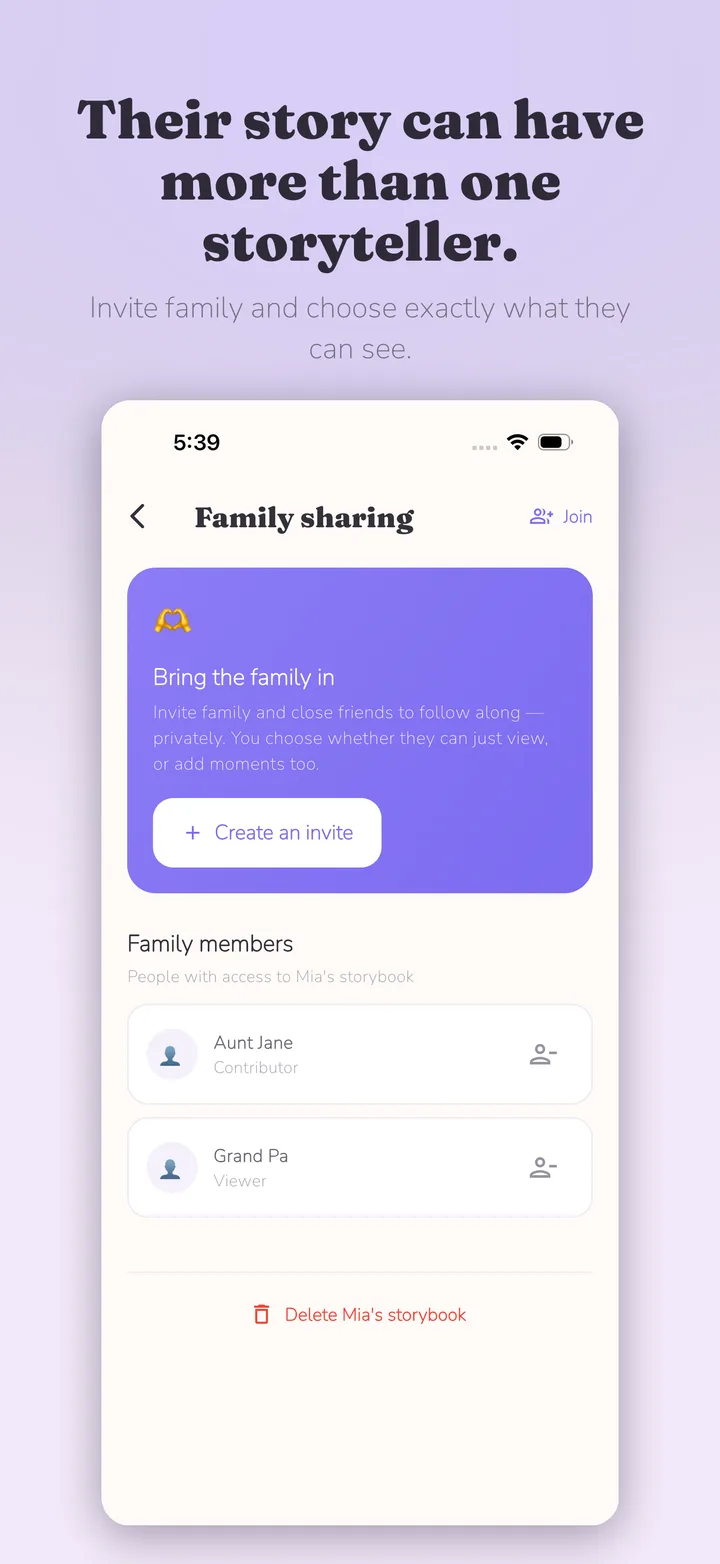
Kiddings is built around Quotes, Questions, Moments and Milestones, with stories organised by child and age. Text, photos, videos and voice notes can sit alongside those entries. That makes the starting point a child's words or experience, with media there to add context.
When you want a paper collection to read together, you can export a printable PDF and choose an online printer or a neighbourhood print shop. Paper, binding and cost depend on the printer and your choices. Kiddings provides the PDF; your chosen printer produces the book. Read more about turning family memories into a keepsake book.
However you keep the stories, start with one you would enjoy telling tonight.
Read the line. Explain the bit around it. Leave room for a correction, a question or an entirely unexpected observation.
You may discover that the story you saved has acquired another small chapter.
Research and further reading
- Reese and Newcombe, 2007: a parent reminiscing intervention and children's memory narratives.
- Wu and Jobson, 2019: a meta-analytic review of maternal reminiscing and children's memory elaboration.
- Mitchell and Reese, 2022: an adolescent follow-up of the Growing Memories intervention.
- Bauer and Larkina, 2014: a prospective study of forgetting early childhood events.

Start with one moment today.
Kiddings is a private, ad-free storybook for your child’s words and little moments.