Memory Keeping
How to Write a Letter to Your Child: Examples and a Simple Template
Learn how to write a meaningful letter to your child with a simple structure, practical prompts, fictional examples and a copyable template.
Writing a letter to your child sounds easy until you open a blank page.
You know the child. You have material. In the last week alone, they may have asked whether fish get thirsty, worn a cape to the supermarket, and become furious because their banana was “too banana.” Yet the moment you begin a letter, every true detail leaves the room and is replaced by phrases usually printed inside greeting cards.
Do not try to explain your entire love, summarize a childhood, or supply advice for every future difficulty. Write about this child at this age, in this season of family life. Include one or two real stories, preserve their exact words, say what you notice, and end before the letter becomes a keynote address.
The short answer: what to write in a letter to your child
A meaningful letter to your child can include six things:
- Why you are writing today
- A clear picture of who they are right now
- One specific story or ordinary moment
- Their exact words, question, or current obsession
- Something you appreciate about them without turning it into a demand
- A simple closing message they can carry forward
That is enough. A useful letter may be 300 words or one handwritten page. It does not need to be saved until adulthood, sealed with wax, or written while meaningful piano music occurs in the background.
Here is the basic shape:
Dear [name],
I am writing because [occasion or reason]. Right now, you are [age and a few true details].
Lately, [specific story, Quote, Question, Moment, or Milestone].
I notice and appreciate [specific quality or effort].
I hope you remember [brief message without prediction or pressure].
Love,
[name and date]
The rest of this guide will help you fill that structure with something that sounds like you and belongs unmistakably to your child. All sample scenes and child quotations below are invented illustrations; replace them with details from your own family.
Start with a reason, not a grand purpose
“I should write my child a meaningful letter” is too large to be useful. Choose a smaller reason.
You might write on a birthday, after a move, at the end of a school year, when a funny phase begins to fade, or after an ordinary day you do not want to lose. The occasion gives the letter edges. A birthday letter can describe the year; a moving letter can preserve a home; an ordinary-day letter can explain why this unremarkable Tuesday was the whole point.
You do not need to wait for a milestone. “Today you built a vet's office under the dining table and charged me two buttons to have the dog examined” is a sufficient reason to write.
Write a portrait of the child as they are now
Begin with details a future reader could not reconstruct from a date or photograph.
Instead of:
You are a wonderful eight-year-old and we are very proud of you.
Try:
You are eight. You read at breakfast if nobody stops you, keep interesting stones in three different coat pockets, and still run back upstairs most mornings because your toy fox needs to “see the day begin.”
The second version is more recognizable because it contains evidence.
Useful details include:
- What they call a person, object, or place
- The book, song, game, food, or subject they return to
- A ritual they insist on
- Something they recently learned
- What currently makes them laugh
- What they are trying hard to do
- The clothes or objects that go everywhere
- A question they keep revisiting
- The way they greet someone they love
- An ordinary habit you suspect will disappear
Choose two or three. A portrait is not an inventory.
Build the letter around one true story
Specific stories prevent a letter from floating into general praise.
Choose one event with a beginning, a change, and a detail worth keeping. It may be a Quote, Question, Moment, or Milestone.
A Quote
Preserve the child's exact language and the situation around it.
Yesterday, while we were carrying groceries upstairs, you told me, “Being helpful makes my arms tired but my heart fast.” You were holding one loaf of bread. It was, according to you, the important bag.
A Question
Keep the question and the logic behind it, not merely the eventual answer.
This month, you asked whether the moon follows every car or only ours. You watched it through the window all the way home and were not entirely satisfied by my explanation.
A Moment
Ordinary moments often create the warmest letters because they show family life from inside.
On Saturday, you set the table without being asked, then made a place for the stuffed penguin because “he has had a complicated week.” Nobody knew what had happened to him. We respected his privacy.
A Milestone
Record more than the achievement. Include what it cost, what surprised the child, or what happened immediately afterward.
You rode your bicycle to the end of the path without help. When you stopped, you did not cheer. You checked whether we had all seen it, nodded once, and asked for a snack.
The story does not need to prove a quality. Let it reveal the child without adding, “This demonstrates your exceptional perseverance and leadership.” Sometimes it demonstrates that cycling creates hunger.
Keep their exact words separate from your interpretation
Children's language is easy to improve accidentally.
Your child says, “I did it even though my knees felt worried.” The adult translation becomes, “You were courageous despite feeling nervous.” The translation is tidy. The worried knees are the reason the sentence belongs to this child.
Write the original wording first. If context is needed, add it afterward:
You said, “My knees felt worried.” You meant that you were nervous before going onstage.
This distinction is especially useful when you and your child remember an event differently. A letter can hold both versions:
You say you were not frightened by the large dog; you were “careful about its opinions.” I remember you holding my hand very tightly. Both may be true.
Do not place words in the child's mouth because they would make a better story. If you cannot remember an exact phrase, say so:
I do not remember your precise words, but you asked whether Grandma had been a child when the world was black and white.
Honest approximation is better than a polished quotation nobody actually said.
Say what you appreciate without assigning a role
A loving compliment can become heavy when it tells a child who they must continue to be.
Compare:
You are the brave one in our family. You never give up.
with:
I noticed how you returned to the pool after the first lesson felt difficult. You were still unsure, and you tried again when you were ready.
The first assigns a permanent identity. What happens on a day when the “brave one” feels afraid? The second appreciates a real choice without requiring lifelong consistency.
Be careful with familiar roles:
- The smart one
- The easy child
- The responsible sibling
- The funny one
- The helper
- The talented one
- The child who never complains
These descriptions may sound positive, but they can narrow the letter. Write about what the child did, valued, noticed, or worked through instead.
You can also appreciate qualities with no achievement attached:
- The care they take arranging tiny objects
- The questions they ask on walks
- The way they welcome a friend
- Their delight in a ridiculous song
- Their ability to become fully interested in a puddle
Affection does not need supporting exam results.
What not to put in the letter
Avoid turning the page into:
- A performance review with improvement targets
- A prediction about the career or person they must become
- Twelve life lessons wearing stationery
- An embarrassing story shared without care
- A comparison with a sibling
“Right now, you want to know how everything works” honors the present. “You will become a great scientist” recruits the future. One honest thought may belong, but advice should not crowd out the child who exists today.
Consider who may read the letter now or later. If the child is old enough, ask whether they want a private detail included or shared. Write each child their own letter rather than using one page to explain how different the siblings are.
If you are keeping memories for several children, a simple system can help without demanding identical word counts. This guide to organizing childhood memories for multiple children focuses on meaningful coverage rather than mathematical fairness.
A simple letter-to-your-child template
Copy this structure and delete any prompt that does not fit.
Heading
Child's name:
Age:
Date:
Place:
When they will read it: now / later / not decided
Letter
Dear [name],
I am writing this today because...
Right now, you are [age], and lately you...
One thing I want to remember about this season is...
You recently said or asked...
One ordinary moment that feels like you is...
I noticed you [specific effort, kindness, curiosity, change, or choice]...
Something happening in our family or the wider world that gives this letter context is...
I hope you always know...
Love,
[Name]
Context to save with the letter
- Who was living at home
- Important people in the child's life
- Current favorite things
- One photograph, if it adds useful context
- Whether any detail should remain private
- Tags or words that will help you find it later
Do not answer every prompt. Pick the ones that produce a true letter rather than a completed form.
An imaginary birthday letter example
This example is fictional and is included only to demonstrate length, specificity, and tone.
Dear Leo,
Today you are seven. The kitchen is still decorated with paper planets from yesterday's party, and there is blue icing in a location on the ceiling that none of us can explain.
Right now, you are interested in space, maps, and whether every family should have an emergency biscuit supply. You read the weather forecast aloud each morning, but only after announcing your own forecast, which is usually “possible socks.”
One moment I want to keep happened last month when your little cousin was afraid to go down the tall slide. You did not tell her it was easy. You sat beside her and described exactly where it became fast. Then you went down together. On the way home, you said, “Being brave is easier with company.”
I appreciated the way you took her fear seriously. I also want you to know that you do not always have to be the helper. You are allowed to need company too.
I cannot know which parts of being seven you will remember. I hope this letter gives you one small view from here: paper planets, mysterious icing, serious maps, and a family very glad to know you exactly as you are today.
Love,
Dad
The letter does not cover the whole year. It offers a scene, a few present-day details, one Quote, one Moment, and a closing message. That is enough to feel complete.
A shorter letter for a busy birthday
If you have ten minutes, use this version:
Dear [name],
Today you are [age]. Right now, you love [specific interests, people, rituals, or objects].
This year, I want to remember [one true moment]. You said, “[exact words],” and I noticed [brief context].
I appreciate [specific quality, effort, or choice]. I hope you know [one clear message].
Love,
[name and date]
A precise half-page often carries more life than four pages of phrases that could belong to anyone.
How to adapt the letter by age
For a baby or toddler
Write what daily life looks like: the song that settles them, the object they carry, a new gesture, and how they greet familiar people. Do not predict a personality from ordinary behavior. Six thrown spoons may indicate determination, or the spoon may simply have had an interesting afternoon.
For a young child
Include exact Quotes and Questions, pretend games, favorite objects, and new capabilities. Read it aloud if they wish; let them correct it, add a drawing, or dictate the final line.
For an older child
Ask whether they want the letter now or later. Avoid narrating private friendships, worries, or school experiences without consent. Focus on what you notice rather than what you monitor.
For a teenager
Write to the person in front of you, not the small child you miss. Do not use a letter to bypass a conversation you need to have directly. If it contains an apology, make it an actual apology. Give the teenager control over privacy and timing.
For an adult child
Use the same specificity and honesty. Write about a current season, shared memory, something you understand differently now, or family context they may not know.
Should you write one letter or a series?
Either works. One letter is valuable; no annual commitment is required. For a series, choose a rhythm you can sustain—perhaps birthdays, school years, or meaningful transitions—and use a consistent title such as Letter to Maya — Age 8. If you miss a year, continue with the current one rather than creating a catch-up project.
Save the source memories before writing
A letter becomes easier when you are not asking your brain to produce a year from nothing.
Collect a small set of source memories: two Quotes, one Question, two ordinary Moments, one Milestone, a current favorite, and a detail about home or family life. You will not use everything; the list gives you choices.
In Kiddings, those story types—Quotes, Questions, Moments, and Milestones—can be kept with the relevant child and age, backdated when needed, and found later through search, filters, favorites, and tags. Photos, video, or voice can support a story, but the written context remains the useful center.
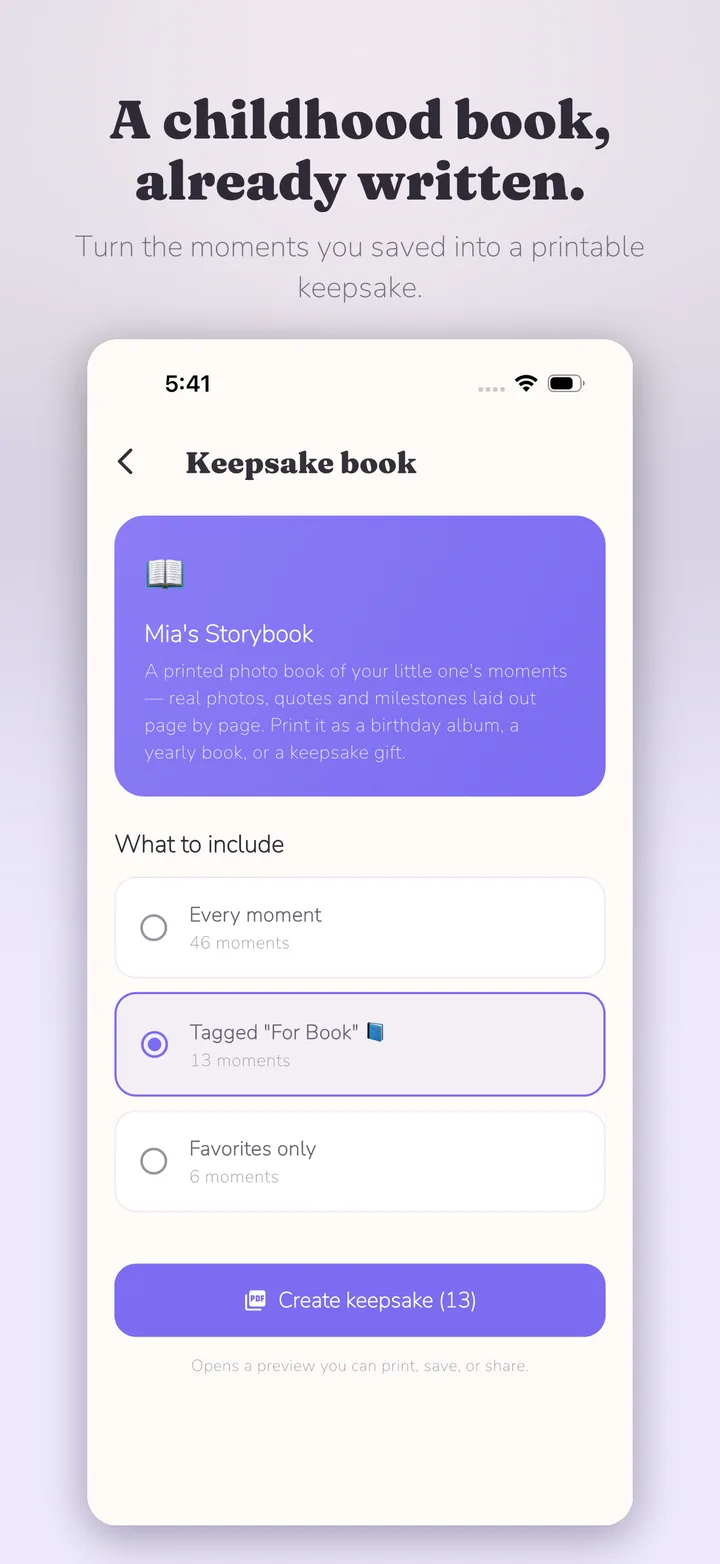
When several saved memories belong together, they can be selected for a print-ready PDF. Parents can choose an online printer or neighborhood print shop rather than relying on one proprietary book service. That offers control over paper, format, quantity, and timing, but it is not guaranteed to be cheaper; cost and quality vary by provider, region, specifications, binding, and shipping. Kiddings does not print or ship the book.
For a broader keepsake workflow, read how to turn family memories into a keepsake book.
A final check before you keep or give the letter
Read the letter once and ask:
- Could this letter belong only to this child?
- Did I include at least one concrete story?
- Are quoted words accurate?
- Did I separate appreciation from expectation?
- Have I included anything private that the child may not want shared?
- Does the letter sound like me rather than a greeting card committee?
- Can I remove one paragraph of advice?
Then stop editing.
Your child does not need the definitive account of how much they are loved. They need a true piece of it, placed somewhere they can find.
Explore Kiddings and save the Quotes, Questions, Moments, and Milestones that could become the next letter.

Start with one moment today.
Kiddings is a private, ad-free storybook for your child’s words and little moments.