Memory Keeping
How to Save the Funny Questions Your Kids Ask
Kiddings created this guide. You can use the method with any journal, notes app, or memory system.
All child questions, family scenes, and names in the examples are fictional.
Save the funny questions your kids ask with exact wording, age, context, and their little theories. Includes a quick template and three fictional worked examples.
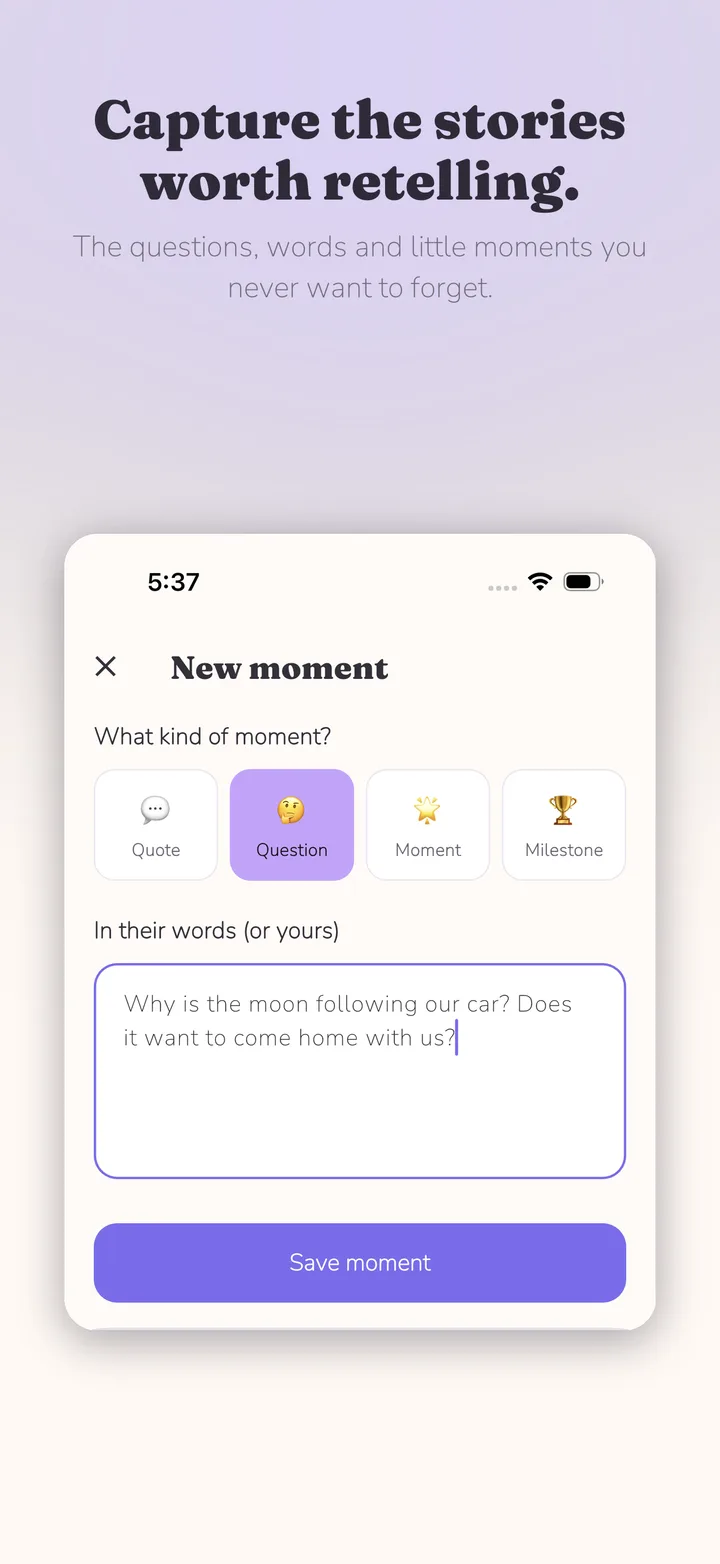
To save a funny question your child asks, write down the exact question first. Then add their age, where you were, what prompted it, what they thought the answer might be, and any follow-up question. A short entry preserves much more than the punchline.
The question is funny now. The explanation behind it is often the part you will want later.
For example, “Do fish get thirsty?” is worth keeping. But this is better:
Question: “Do fish get thirsty, or are they already finished?”
Age: 4 years, 8 months
Context: Watching a goldfish at the dentist’s office
Their theory: Fish must stop drinking when they are “full of water”
Follow-up: “How do they tell the water to stay outside?”
That small record holds the wording, the misunderstanding, the logic, and the setting. It preserves how the child was trying to make the world behave itself.
Why questions deserve their own place
Parents often save funny statements as quotes. Questions can disappear into the same general category, but they reveal something slightly different.
A quote captures what a child said. A question captures what they were trying to work out.
It may contain a new word used with great confidence, an assumption nobody realized they had made, or a perfectly reasonable theory built from incomplete information. Children are excellent at finding gaps in the adult explanation, usually while the adult is reversing into a parking space.
This is why Kiddings treats Questions as one of four first-class childhood story types, alongside Quotes, Moments, and Milestones. A question can be saved with the relevant child, date, age, and context rather than buried in a general photo caption.
You do not need a dedicated app to use the method in this guide. You need a quick place to write, a repeatable entry format, and the restraint not to improve the child’s wording after the fact.
Save the exact wording first
The most important part of a question entry is the child’s actual sentence.
Write it down before explaining it, correcting it, or rebuilding it into smoother grammar. Small details carry personality:
- the word they invented;
- the unusual order of the sentence;
- the object they confused with another object;
- the name they gave something they had never seen before; or
- the pause that changed the meaning entirely.
If you remember only the meaning, label it as a paraphrase. Do not place quotation marks around a polished reconstruction and let future readers assume it is exact.
Compare these two entries:
Exact: “When my birthday is finished, am I still seven tomorrow?”
Honest paraphrase: Asked whether turning seven lasted only for the birthday.
Both are useful. Only one claims to preserve the exact words.
If pronunciation is central to the memory, add a short voice note—with the child’s awareness when appropriate—instead of trying to invent a phonetic alphabet at the kitchen counter. Text preserves the question; audio can preserve how it sounded.
Add the question behind the question
A child’s first sentence may not reveal what they actually mean. Before giving the complete adult answer, try one gentle follow-up:
- “What made you wonder that?”
- “What do you think?”
- “How do you imagine it works?”
- “Is there another part you are wondering about?”
The goal is not to test them or manufacture a cuter answer. It is to understand the route they took to the question.
Suppose a child asks, “Does Grandma turn off when she goes to sleep?” The first reaction may be to reassure or correct. A calm “What do you mean by turn off?” might reveal that they are thinking about a video call ending, not life, death, or sleep. The context changes the story completely.
You do not have to keep asking. If they shrug, move on. A memory entry should not become a deposition.
Record the theory, not only the joke
The child’s proposed answer is often the richest part of the entry.
They may believe:
- the moon follows the family car because it is lost;
- adults know every rule because they receive a manual;
- birds sit on wires to charge themselves;
- elevators decide who goes first; or
- the weekend begins when someone makes pancakes.
These are fictional examples, but they show the pattern: the theory joins two real observations with one imaginative bridge.
Write the theory in the child’s words when you can. If you summarize it, say that you are summarizing. Do not turn it into a lesson about intelligence, development, or personality. You are recording one conversation, not issuing an assessment.
Also keep the adult answer short in the entry. Years later, nobody will need your complete explanation of municipal drainage. They may want to know that the question began when a leaf disappeared into a gutter and your child concluded that the street was eating salad.
Use this quick question-entry template
Copy this into your preferred journal or notes app:
Question:
Exact words or paraphrase:
Child and age:
Date:
Where we were / what was happening:
What prompted it:
What they thought the answer might be:
Follow-up question:
My short answer or reaction:
Related photo, video, or voice note:
You rarely need every field. The minimum useful entry is:
Question + child + age + one sentence of context
Use the full version when the theory or conversation is especially worth keeping.
Three worked question entries
1. The question with a hidden assumption
Question: “Who teaches babies their first language before they can talk?”
Child and age: Amara, 6 years, 2 months
Context: Her baby cousin made a squeaking noise during lunch
Her theory: Babies attend “silent lessons” while asleep
Follow-up: “Is that why they nap more than us?”
Adult response: Explained that babies learn gradually by hearing people around them
The memorable part is not simply the language question. It is the invisible classroom Amara invented to explain learning before speech.
2. The question caused by a word
Question: “If this is a building, why are they already done building it?”
Child and age: Noah, 5 years, 1 month
Context: Waiting outside the library
His theory: A completed building should be called a “built”
Follow-up: “Are old buildings builts?”
This entry needs no photograph. The word problem is the whole event.
3. The question that continued later
Question: “Where does the dark go when you open the fridge?”
Child and age: Jun, 4 years, 5 months
Context: Looking for strawberries before breakfast
Initial theory: The light pushes the dark behind the food
Later follow-up: At bedtime, asked whether bedroom darkness also hides behind furniture
The follow-up belongs with the first entry because it shows the idea continuing. Searchable text or a shared tag can connect the two moments if you save them separately.
Capture now; tidy later
The largest practical problem is not choosing a system. It is remembering the question ten minutes after it happens.
Use the quickest capture method available:
- type the exact words into a note;
- dictate a rough entry to yourself;
- send yourself a private draft message;
- write it on paper; or
- save it directly in your chosen childhood journal.
At capture time, prioritize exact wording and one clue about the setting. You can add the date, age, theory, and follow-up later that day.
A temporary note might say:
“Can a shadow get lost?” — Mina, bus stop, after she stepped away from the shelter.
That is enough to recover the scene. “Funny shadow question” probably is not.
If daily journaling feels unrealistic, the guide to keeping a parenting journal when you have no time offers a lighter capture-first routine.
Keep questions separate from answers you prompted
There is a useful difference between a spontaneous question and an answer produced by an adult interview.
If you ask, “What do you think clouds are made of?” and the child says “old bath bubbles,” save that as a conversation or answer—not as a question the child asked. It is still delightful. It is simply a different event.
Labeling the source protects the honesty of the collection:
- Child’s spontaneous question: they asked without prompting.
- Child’s theory: their proposed explanation.
- Adult prompt: the question you asked them.
- Child’s answer: their response to your prompt.
This distinction matters more over time, when nobody remembers who started the exchange.
For a deliberate annual interview, use a repeatable set of prompts. For everyday questions, keep the original spark and the scene around it.
Do not correct the memory into blandness
Correct the misunderstanding in the actual conversation when needed. Preserve the original wording in the memory.
Those two actions are compatible. A parent can explain that birds are not charging on power lines while still recording the theory exactly as it appeared.
Avoid edits that make the child sound older, tidier, or more deliberately funny. Also avoid adding a dramatic reaction that did not happen. “We all collapsed laughing for ten minutes” is less useful than “I laughed, and she looked annoyed because the question was serious.”
The child is not performing for the archive. They are trying to understand something.
Organize question entries so you can find them
A date and age are more useful than a clever title. Add both whenever possible, along with the relevant child when you have more than one.
In Kiddings, a parent can choose Question as the entry type, select the child, backdate an older memory, and add text, a photo, video, or voice note. Entries are organized with child and age context and can be found later through search, filters, favorites, and tags.
Useful manual tags might describe a recurring thread:
- animals;
- space;
- words;
- bodies;
- family;
- machines; or
- bedtime.
Use only tags that help you retrieve something. If tagging takes longer than saving the question, the filing system has eaten the memory.
Revisit a few questions together
Choose a handful once or twice a year. Read the original wording and ask the child what they think now—only if they are interested. Save the new answer as a separate update rather than replacing the old one.
Do not make the review a quiz or a compilation of embarrassing mistakes. Let a child skip any entry they no longer want discussed or shared. The point is to notice how ideas change, not to prove that an earlier self was wrong.
If you later curate selected memories into a keepsake, questions can sit beside Quotes, Moments, and Milestones rather than forming a book of jokes at the child’s expense.
Frequently asked questions
Should I save every question my child asks?
No. Save the questions with distinctive wording, an interesting theory, a memorable setting, or a follow-up you want to remember. Selection keeps the collection readable.
What if I cannot remember the exact words?
Write an honest paraphrase and label it as one. Context recorded accurately is more valuable than a quotation reconstructed with false confidence.
Is a voice recording better than text?
They preserve different things. Text is quick, searchable, and easy to reread. A voice note can preserve pronunciation, timing, and tone. Use both when the sound is part of the memory, but do not delay a text entry because recording is inconvenient.
What if the question is private or sensitive?
Keep it private, summarize it cautiously, or do not record it. A future memory is not more important than a child’s dignity now.
Keep the question and the little theory beside it
When a child asks something worth saving, begin with the exact words. Add their age and one sentence about what was happening. If there is time, ask what they think and keep the follow-up.
You are not building a complete transcript of childhood. You are saving a few moments when a child looked at an ordinary world, noticed that part of it made no sense, and asked the question the adults had stopped seeing.

Start with one moment today.
Kiddings is a private, ad-free storybook for your child’s words and little moments.