Memory Keeping
How to Make a Baby Time Capsule: What to Put Inside and What to Write
Kiddings created this guide. You can make the capsule with an ordinary box and record the supporting stories in any private journal or memory system.
All names, letters, family details, and child scenes in the examples are fictional.
Make a baby time capsule with a meaningful letter, labeled keepsakes, and clear opening instructions. Includes letter prompts and a fictional example.
To make a baby time capsule, choose the date it will be opened, write a letter to your child, add a small set of durable items or copies that describe their early life and family, label everything with context, and seal the collection. Keep a separate note of the opening date, location, and person responsible for it.
The strongest capsule answers a future child’s likely questions: Who were we then? What was ordinary in our home? What did you notice about me? What did you hope I would know?
Kiddings can hold the searchable stories behind a capsule—Quotes, Questions, Moments, and Milestones organized with child and age context—but it is not a physical time-capsule service. You choose, prepare, store, remember, and eventually open the container.
What is a baby time capsule?
A baby time capsule is a deliberately limited snapshot created during pregnancy, around a birth, on a first birthday, or during another early milestone. It is sealed with a chosen future opening date.
That last part distinguishes it from a baby memory box.
A memory box remains open and changes over time. You add an outgrown shoe, a card, a hospital bracelet, or a toy as childhood unfolds. A time capsule is edited once, closed, and allowed to become a message from one moment to another.
The opening date could be a tenth or eighteenth birthday, graduation, or another date that suits your family. Choose the recipient and occasion before choosing the contents.
Start with the opening date
Write the exact opening instruction before gathering anything:
For: [child’s full name]
Created: [date]
Open on: [date or occasion]
Created by: [names]
Current custodian: [name]
Stored at: [clear location]
Place one copy on or inside the capsule. Keep another outside it with your important household records or another place you already review.
Do not rely on a single future phone reminder created eighteen years in advance. Devices, accounts, calendars, homes, and responsible adults can all change. Tell at least one other trusted adult that the capsule exists and where the retrieval note lives.
If the family moves, update the separate location note without opening the capsule.
What to put in a baby time capsule
Choose a few items from several categories rather than filling the box with every possible first-year object.
1. A letter to the child
The letter is the center of the capsule. It carries information no object can supply: your voice, the circumstances of this moment, and what you want the future reader to understand.
Write one shared family letter or separate letters from parents, grandparents, siblings, or other important people. Nobody needs to sound ceremonial. Specific details usually travel better than grand declarations.
2. A photograph of the ordinary home
Include a printed copy of a scene the child would not otherwise remember: the corner where bottles dried, the chair used during night feeds, the view from the window, or the family gathered without matching clothes.
A formal portrait shows faces. An ordinary room shows life.
Add names, the date, location, and one sentence explaining what is visible. “Our kitchen” will be less helpful later than “The kitchen in our first apartment; your chair was beside the radiator because every other arrangement blocked a cupboard.”
3. A few details from the child’s early life
Choose details that show personality and context rather than turning the capsule into a completed checklist.
You might include:
- a sound or expression the baby made often;
- a soothing routine;
- a favorite object;
- a first Quote or Question, if the capsule is made later;
- a Moment that changed the household rhythm;
- a Milestone and how the child reacted;
- the story of their name; or
- a description of a typical morning.
If you record an exact Quote, preserve the wording. If you remember only the meaning, label it as a paraphrase.
4. One small, ordinary object or a durable copy
An object can make the era tangible without needing to be valuable. Consider a duplicate announcement, a copy of a card, a clean fabric swatch from a familiar blanket, a printed family recipe, or a small paper item connected to a real story.
Explain why it is present. An unlabeled object asks the future reader to guess.
If the original is fragile, irreplaceable, actively used, or difficult to store, include a photograph or copy instead. The capsule is not improved by trapping the family’s only copy of something important.
What to write in the letter
A letter to a baby can feel difficult because the future recipient is both deeply familiar and almost completely unknown.
Use five parts:
1. Introduce the present moment
Say when and where you are writing, how old the child is, and what is happening nearby.
2. Describe the child as they are now
Include observable details: the expression they make before sneezing, the sound that makes them turn their head, the way they hold a spoon, or the toy inspected every morning.
Avoid assigning a permanent identity to temporary behavior. “You always loved people” is broader than the evidence. “This month you smiled whenever the neighbor sang in the hallway” is a memory.
3. Describe the family’s current life
Write about the people, home, routines, and small adjustments surrounding the child. Include a detail that would never appear in an official record.
4. Say what you hope they understand
You can express love, welcome, curiosity, or a family value without dictating a future career, personality, relationship, or life plan. Leave space for the person they become.
5. End with an invitation
Ask the future reader what surprised them, what remained familiar, or what they want to know about this period. A time-capsule letter can begin a later conversation rather than deliver a final statement.
For a deeper letter template and adaptable examples, see how to write a letter to your child.
A completed fictional letter excerpt
Dear Sam,
I am writing at the small table beside the kitchen window on March 8, 2026. You are ten months old and asleep in the next room after spending lunch dropping the same wooden spoon seven times to check whether gravity had changed.Our apartment is noisy at five in the afternoon because the school across the road finishes then. You stop whatever you are doing when the crossing guard whistles. This week you have also begun waving at the washing machine. We do not know whether you believe it is leaving.
Your aunt calls every Sunday. Your grandfather visits with a different fruit each time and asks you for a review. So far, pear has received the most serious expression.
When you open this, I hope you recognize that we were learning you while you were learning everything else. You did not need to become the person we imagined. We wanted the chance to meet the person you became.
Tell us which detail in this box feels most surprising—and whether washing machines still deserve a farewell.
The excerpt is fictional. Its usefulness comes from concrete life around the baby, not a claim to know their future.
Add a short “world around us” page
The future reader may be curious about the broader moment. Keep this section dated, local, and modest.
Use prompts such as:
Where we lived:
How we usually traveled:
Technology we used every day:
A local place we visited:
A meal we made often:
Music or stories in the house:
What a normal weekday looked like:
One change happening in our family or community:
If you include a factual detail, write its date and source on the page. The capsule should preserve your perspective without presenting guesses as history.
What not to put inside
Leave out items that may create practical, privacy, or retrieval problems:
- food or anything perishable;
- batteries or powered items left with batteries installed;
- liquids;
- essential original documents;
- passwords, access codes, financial details, or identity information;
- medication;
- an irreplaceable object you may need before the opening date;
- a digital file with no separate readable description; or
- private information about another person that they did not agree to include.
Choose ordinary durable copies and written context instead. For a delicate, valuable, or historically significant item, seek advice appropriate to that specific material rather than relying on a general family guide.
Connect the sealed capsule to an ongoing journal
The capsule captures one point in time. An ongoing journal records the life that follows.
In Kiddings, parents can save Quotes, Questions, Moments, and Milestones for the relevant child, backdate older memories, add text, photos, video, or voice notes, and later find entries through search, filters, favorites, and tags. A manual tag such as “Time Capsule” can identify the stories or copies selected for the physical box.
Kiddings does not seal the capsule, track its physical location, enforce an opening date, or automatically deliver its contents in the future. Keep those instructions outside the box yourself.
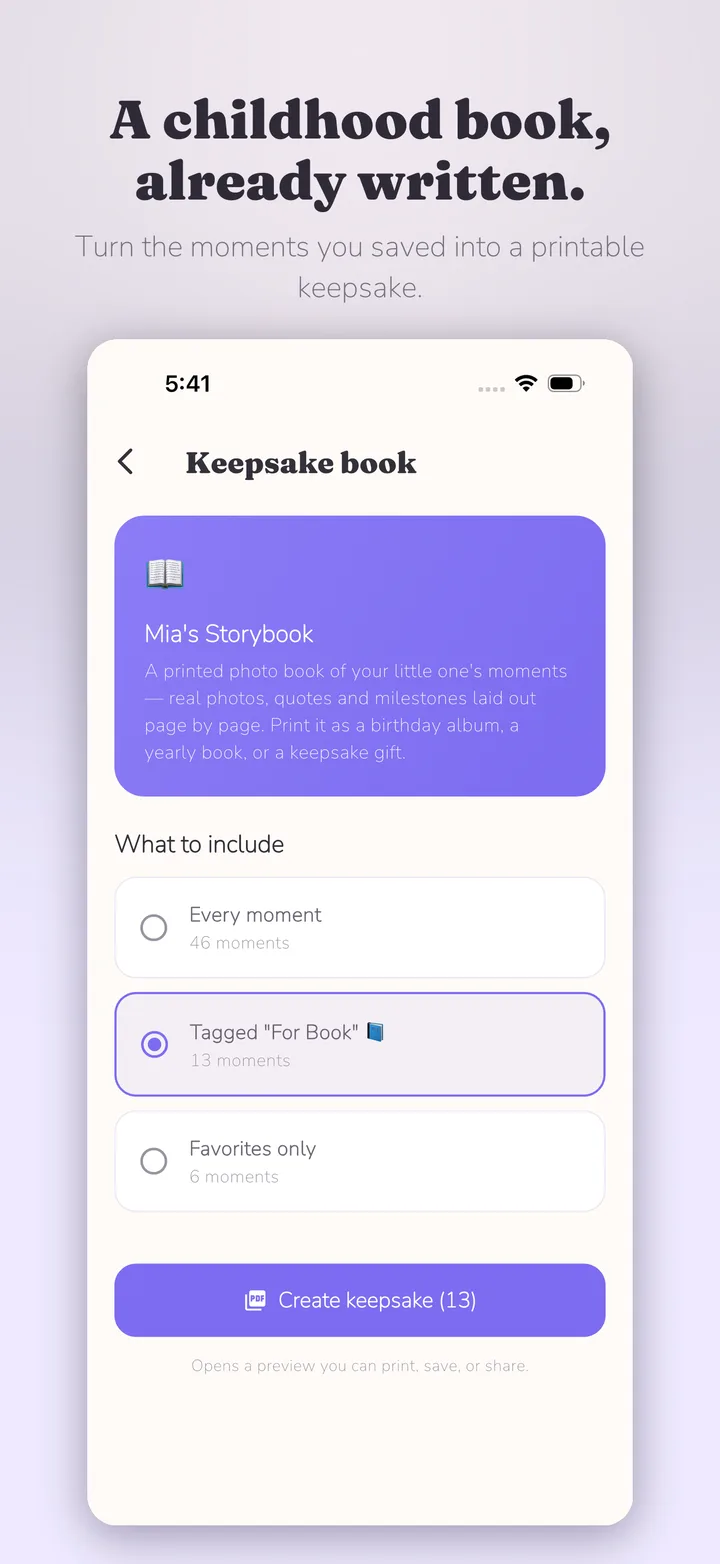
If you want a readable companion rather than loose printouts, selected Kiddings memories can be exported as a print-ready PDF. You choose an online printer or neighborhood print shop; Kiddings does not order, print, bind, or ship the book. Cost and quality vary by printer, region, paper, format, binding, quantity, and shipping.
Seal it without making it disappear
Before closing the capsule:
- Read the letter once for names, dates, and accidentally missing pages.
- Label every photograph and unexplained object.
- Put the opening date and recipient on the container.
- Create a separate list of contents.
- Record the storage location outside the capsule.
- Tell another trusted adult where that record lives.
- Decide what should happen if the family moves before the opening date.
Do not hide it so successfully that the future becomes an archaeological project.
Frequently asked questions
When should a baby time capsule be opened?
Choose a date that matches the contents and intended reader. A tenth birthday suits a child-facing capsule; an eighteenth birthday or later milestone allows a different kind of letter. There is no universal correct date.
Should guests contribute letters?
They can, if participation is optional and the purpose and opening date are clear. Ask contributors to date and sign their messages. Do not require predictions about the child’s future.
Can the capsule be digital?
Yes, but this guide does not promise that any particular file format, account, device, or storage service will remain available until the opening date. Keep clear filenames, context, more than one maintained copy, and a plain-language inventory of what exists.
Should I keep adding things every year?
Not to the same sealed capsule. If you want an annual practice, create separate dated letters or capsules with their own opening instructions. Otherwise, keep an ongoing journal and let the original capsule remain a snapshot.
Make a small, understandable message to the future
Choose the opening date first. Write one specific letter. Add a photograph of ordinary home life, a family snapshot, a few early-childhood details, and a small number of labeled objects or copies. Keep the retrieval instructions outside the box.
The future reader does not need every artifact from the year they arrived. They need enough context to meet the family who was already making room for them.

Start with one moment today.
Kiddings is a private, ad-free storybook for your child’s words and little moments.