Memory Keeping
Birthday Interview Questions for Kids: 40 Prompts to Ask Every Year
Find 40 birthday interview questions for kids, a simple annual template, age-friendly tips, and ways to save their answers as a childhood keepsake.
A birthday interview is a short set of questions you ask your child around the same time each year. Keep the answers in their own words, add their age and the date, and repeat a small core set annually.
The result is not a test, a developmental record, or an attempt to make a six-year-old explain the meaning of life before cake. It is a snapshot of what matters to them now: the cereal they would defend in court, the friend who makes them laugh, the thing they can finally do, and the question currently occupying most of their brain.
If you want the simplest version, ask the ten recurring questions below. They are broad enough to work year after year and specific enough to produce answers more interesting than “fine.”
10 birthday interview questions to ask every year
- What is your favorite thing to do right now?
- What always makes you laugh?
- Who do you love spending time with, and what do you like doing together?
- What is something you are proud of learning or doing this year?
- What is your favorite food at the moment?
- What book, show, song, game, or story do you like best right now?
- What is something you want to learn or try before your next birthday?
- What is one thing grown-ups should know about being your age?
- What was one really good moment from this year?
- What question do you wish someone would ask you today?
These ten are enough for a useful annual tradition. Ask them in one sitting, split them across birthday week, or choose five if everyone is tired and the frosting has entered the upholstery.
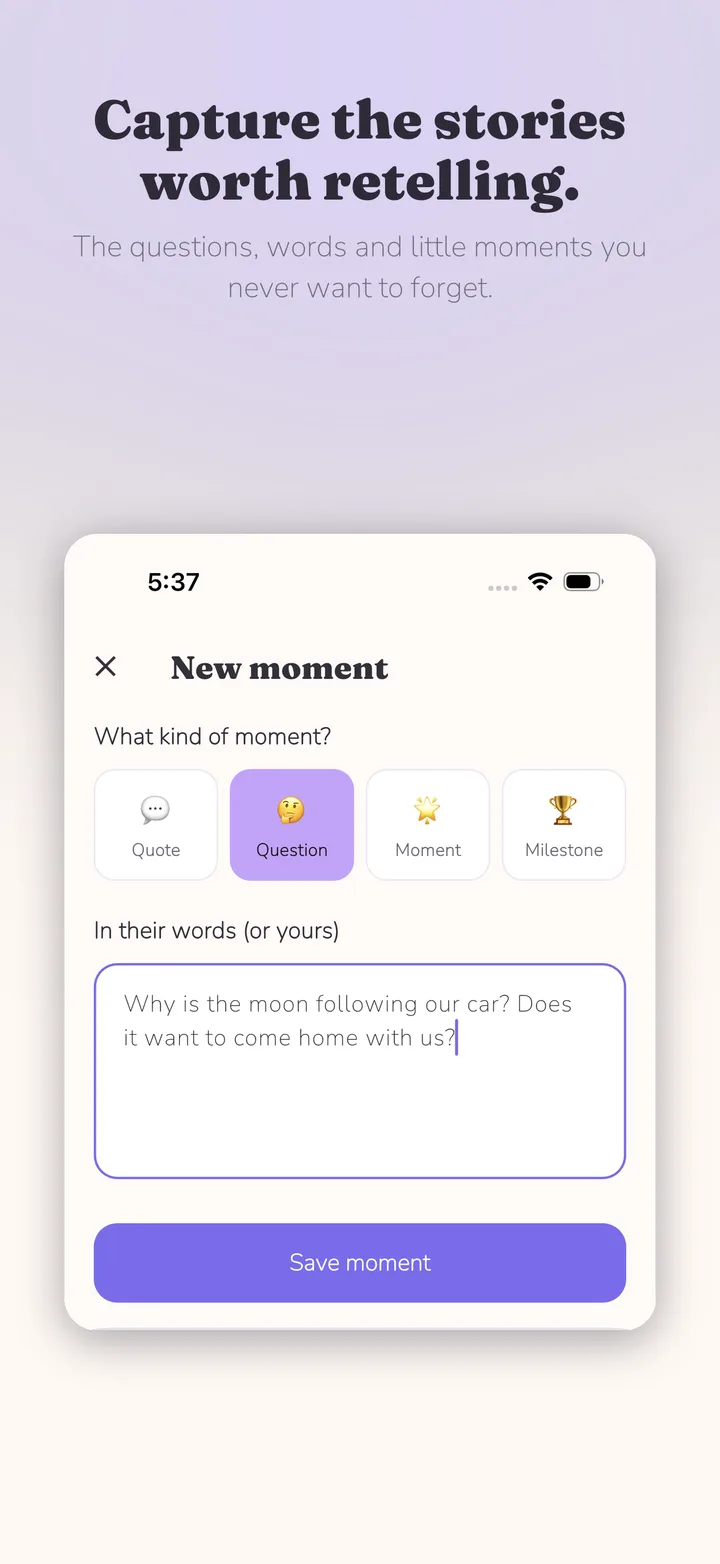
Kiddings can hold each year's answers as a childhood story connected to the child and their age. You can save the exact wording as text, add a supporting photo, video, or voice note, and find the entry again later through search. The interview still belongs to the conversation; the app simply gives the answers somewhere organized to live.
Why repeat some questions every birthday?
The charm is in the comparison.
A child may want to become a firefighter at five, a marine biologist at seven, and “someone who does not have homework” at nine. Their favorite meal may remain pasta with no visible seasoning for six consecutive years. Their definition of bravery may change completely.
Repeating a core set makes those changes visible without requiring you to remember which questions you improvised while carrying a tray of cupcakes. It also creates a familiar rhythm. Children know roughly what is coming and can notice their own changing answers.
Not every answer will change. Repetition can be just as revealing. A friend, obsession, joke, or family ritual that survives several birthdays tells its own story.
Keep the repeated set small. Ten questions can leave room for a conversation. Forty mandatory questions can feel like an interview conducted by a very cheerful government department.
Use the remaining prompts as a menu. Choose the categories that fit your child this year.
30 more birthday interview questions for kids
Favorites and everyday life
These questions capture ordinary details you might otherwise leave out. Birthday photographs will show the cake. They may leave out a child's reasoning about breakfast. Imagine learning that the toast is eaten from the middle outward because the crust “needs time to think.” That explanation belongs in the record too.
- What is the best part of an ordinary day?
- Which place do you most like going to at the moment?
- What toy, object, or possession are you using all the time?
- What is your favorite thing to wear, and why?
- What smell, sound, or taste do you really like right now?
- If you could plan tomorrow's breakfast, lunch, and dinner, what would we eat?
Follow the answer when it opens a door. If the favorite place is the library, ask what they do first when they arrive. If the treasured object is a smooth stone, ask where it came from and what job it performs. It probably has a job.
Imagination and personality
Imaginative questions can reveal a child's current logic without demanding a grand or polished answer. The aim is not to measure creativity. It is to hear how this particular person thinks today.
- If your bedroom had a secret door, where would it lead?
- If you could invent a new holiday, what would people do on it?
- Which animal would be the funniest teacher, and what would it teach?
- If you could make one rule that everyone in the family had to follow for a day, what would it be?
- What would you put in a tiny museum about your life right now?
- If this year of your life had a title, what would you call it?
The answer may be one word. Keep it. “The Year of Soup” will either make perfect sense later or become a valuable mystery.
Friends, family, and belonging
These prompts focus on relationships without asking children to rank the people they love. “Who is your favorite?” tends to create unnecessary administration.
- What is something our family does that you hope we always keep doing?
- Who taught you something useful or interesting this year?
- What makes someone a good friend?
- What is something kind someone did for you recently?
- What is a game, joke, or tradition you share with someone special?
- What is one thing you would like to do with the family before your next birthday?
If a child names someone outside the immediate household—a teacher, cousin, neighbor, coach, or the crossing guard who knows every dog's name—write the relationship down. Context that feels obvious now may not be obvious in ten years.
Learning, change, and capability
These questions are about the child's own view of change. They are not a checklist and do not need to focus on school.
- What can you do now that used to be difficult?
- What did you discover this year that surprised you?
- What is something you kept practicing even when it was annoying?
- When did you feel brave this year?
- What would you like help with right now?
- What is something you know a lot about?
A child may be proud of reading a chapter book, learning to whistle, ordering food for themselves, remembering a bus route, or finally touching the bottom of the pool. Let them choose the scale.
Looking back and looking ahead
End with prompts that help the child describe the year in their own terms. Avoid turning the final question into a demand for a five-year plan. Some adults are still considering theirs.
- Which day from this year would you like to visit again?
- What is something you changed your mind about this year?
- What was difficult this year, and what helped?
- What do you hope stays the same while you are this new age?
- What are you curious about for the year ahead?
- What message would you like to leave for yourself to read on your next birthday?
Question 40 creates a natural ending. Do not correct the message or improve its wisdom. “Remember to buy more purple socks” is a perfectly valid instruction to the future.
A copy-and-use birthday interview template
You do not need a designed worksheet. Copy this template into your preferred journal, notes app, or family memory system.
Birthday interview
Child:
Age today:
Interview date:
Where we were:
Who was there:
Mood before we started:Question 1:
Answer in their exact words:
Follow-up detail or context:Question 2:
Answer in their exact words:
Follow-up detail or context:Question 3:
Answer in their exact words:
Follow-up detail or context:Repeat for the questions you choose.
One answer that surprised me:
One phrase I want to preserve exactly:
Photo, drawing, video, or voice note added:
Question the child asked me:
Anything the child wants kept private:
The location and mood fields are optional, but they can rescue useful context. “Kitchen table, wearing a paper crown, impatient for grandparents to arrive” tells a future reader more than the date alone.
How to conduct a birthday interview without making it feel like homework
Choose the right moment, not merely the official day
The birthday itself may be busy, loud, and structurally dependent on sugar. Ask the questions the weekend before, during a quiet breakfast, or across several evenings. The timing can be approximate.
Start with easy, concrete questions
Try beginning with food, games, objects, or places. Move toward pride, difficulty, change, and hopes if the child is engaged. If a question needs a long explanation, simplify it or choose another.
Ask one follow-up, then listen
Useful follow-ups include:
- “What makes you say that?”
- “Can you tell me one example?”
- “What happened next?”
- “Who was with you?”
- “How would you explain that to future you?”
Do not use every follow-up on every answer. “Blue” does not always require an inquiry into the philosophical basis of blue.
StoryCorps' conversation guidance recommends open-ended questions, follow-ups and flexibility when a conversation moves beyond the prepared list. That is a useful approach here: listen for the detail your child wants to explain, even if it takes you away from question six.
Preserve the child's wording
Write what they said, not what you think they meant.
If a child says, “I was brave because I went in even though my tummy was shouting,” keep the shouting tummy. A polished version—“I overcame my anxiety”—removes the person you were trying to remember.
You can add a short parent note afterward to explain the setting. Keep it separate from the answer.
Do not challenge answers for accuracy
The interview records the child's current perspective. If they identify a holiday from three years ago as the best moment of this year, you can gently clarify the time period, but you do not need to litigate the calendar.
Write uncertainty honestly: “She thought this happened after school started; I believe it was during summer.” Memory keeping can tolerate an unresolved date. It is not an audit.
Let them skip questions
Some prompts will not fit. A child may not want to discuss what was difficult, name a friend, or leave a message for the future. Skipping is allowed.
Privacy matters especially when answers concern other children, family conflict, school, health, or fears. Keep sensitive details out of a broadly shared keepsake unless the child understands and agrees.
Birthday interview questions by age and communication style
Age suggestions are practical adaptations, not rules. Children communicate in different ways and may enjoy questions aimed at a younger or older group.
Toddlers and preschoolers
Use short either-or or show-me prompts, then record what happens as well as what is said.
Try:
- “Show me your favorite toy.”
- “Would you rather have pancakes or eggs?”
- “Who makes you laugh?”
- “What sound does your favorite animal make?”
- “What should we play after this?”
Ask three to five questions. Accept gestures, sound effects, pointing, single words, and sudden departures. A toddler leaving halfway through to put a hat on the dog is not a failed interview. It may be the strongest material available.
Children who do not answer verbally
Offer accessible ways to choose or respond: pointing to pictures, selecting objects, drawing, typing, signing, using an established communication device, or asking a trusted adult to support the conversation in the child's usual way.
Do not guess an answer from a photograph and present it as the child's words. Label observations and interpretations clearly:
- Child selected: the yellow train
- Parent observation: smiled and brought it over when asked about a favorite toy
- Parent interpretation: may currently prefer the yellow train
The distinction protects the child's authorship.
Early school-age children
Use the recurring ten, but keep the pace brisk. Let them draw while answering or choose a question number from folded slips of paper. Concrete questions usually lead naturally to stories.
Ask for one example rather than a general explanation: “What made you laugh this week?” often works better than “What is your sense of humor?”
Older children and teenagers
Give them more control. Let them review the questions first, choose which answers are private, type their own responses, or interview the parent in return.
Useful additions include:
- “What do adults misunderstand about people your age?”
- “Which part of your life feels most different from last year?”
- “What are you better at noticing now?”
- “What do you want future you to remember accurately?”
Avoid performing their answers for relatives without permission. A thoughtful annual tradition can end quickly if every response becomes material for the family group chat.
An imaginary birthday interview example
The following example is invented to show the level of detail worth keeping.
Child: Maya
Age: 7 years, 0 months
Place: Kitchen table, Sunday morningWhat always makes you laugh?
“When Dad says he knows where he is going and then the map lady says turn around.”What are you proud of learning this year?
“Going underwater without holding my nose. I still close my eyes because the pool looks too blue inside.”What should grown-ups know about being seven?
“You can do lots of things but people still move the cups to the high shelf.”Parent context: Maya had started swimming lessons that spring. The cup comment referred to the kitchen shelf she had complained about twice that week.
The exact phrases do the important work: “the map lady,” “too blue inside,” and the injustice of elevated cups. A summary such as “Maya likes jokes, improved at swimming, and wants independence” would be accurate and almost entirely lifeless.
Keep the interview with the rest of childhood
A birthday interview is useful, but it should not have to represent an entire year.
The annual answers show what the child thinks when asked to look back. Everyday entries capture what nobody knew would matter at the time:
- A Quote from breakfast
- A Question asked in the car
- A Moment during an ordinary evening
- A Milestone that changed what the child could do
Together, they provide both portrait and plot. The birthday interview says, “This is how I see myself now.” Everyday stories show the small events that helped make the year.
In Kiddings, parents can keep annual interviews alongside those Quotes, Questions, Moments, and Milestones, organized by child and age. Search makes it possible to find each birthday entry later, while favorites and tags can help select memories for a print-ready PDF. Parents choose where and how to print that PDF; Kiddings does not order or ship a book, and printing cost and quality depend on the provider and specifications.
If you have more than one child, keep a distinct entry for each interview and let their answers stand on their own. This guide to organizing childhood memories for multiple children offers a simple way to keep those stories findable.
A five-minute version for busy birthdays
If the full interview is not happening this year, ask five:
- What do you love doing right now?
- What made you laugh recently?
- What are you proud of from this year?
- What do you want to try next?
- What should future you remember about being this age?
Record the date, age, and exact answers. Add one photograph only if you want to. Done.
The tradition does not become more meaningful because the parent used a special pen or asked every question. It matters because the child's current voice and context were kept honestly enough to revisit.
Next year, ask again. The cereal may be the same. Almost everything else will have moved.
When you are ready to gather those answers into something you can read together, see how to turn family memories into a keepsake book.

Start with one moment today.
Kiddings is a private, ad-free storybook for your child’s words and little moments.