Family Stories
30 Questions to Ask Grandparents About Your Child’s Early Years
Disclosure: This guide was written by Kiddings, an app for preserving childhood stories. The questions are original and can be used in any conversation, notebook, document, or recording setup.
Ask grandparents 30 specific questions about your child’s early words, routines, relationships, and milestones—and preserve each story with context.
Grandparents often remember a different version of your child’s early years: the snack requested at every visit, the rules of a made-up game, or the front-door greeting performed for six months. Parents were there too, but also finding shoes and wondering why yesterday’s acceptable cup had become a personal insult.
These 30 questions are designed to recover the grandparent’s memories about your child. They are not a general interview about the grandparent’s own childhood, ancestry, career, or life story.
For a quick start, choose three:
- What is one ordinary scene with my child that you can still picture clearly?
- What did they say or ask that you still repeat?
- What part of their younger personality do you recognize in them now?
Ask one question, listen, and follow the story instead of racing to the next prompt. One detailed scene is more useful than thirty short answers.
What this conversation is for
The goal is to add another witness to your child’s record. A grandparent may have seen the child during a regular afternoon, on school pickup, in a different language, or while the parent was briefly out of the room and missing the important part.
Their account is a perspective, not an official transcript. Two relatives can remember the same birthday differently. A grandparent may remember the emotion but not the date, or combine two visits into one story. Record the memory honestly: “Grandad remembers this happening around age four,” rather than converting uncertainty into a precise fact.
This is not a memory test. Do not correct every date mid-sentence or insist on names they cannot recall. Check important details later against photographs, messages, calendars, or another relative—and keep differing versions when the difference is part of the story.
Before you ask: make the invitation clear
Tell the grandparent what you are doing, how long it will take, and what will happen to the answer. A simple invitation might be:
“I’m collecting a few stories about Maya’s early years. Could I ask you three questions about time you spent together? I’d like to write down your answers for her private childhood journal. You can skip anything, and I’ll show you what I save.”
Before recording audio or video, ask permission and explain who may hear it or whether it could appear in a keepsake. The Oral History Association’s consent guidance emphasizes transparency about participation and use. A family chat is not a formal oral-history project, but the respect principle travels well.
Choose a calm moment and a narrow time frame. “Tell me everything you remember about his childhood” is a substantial assignment. “What was he like when you collected him from preschool on Thursdays?” gives the memory somewhere to begin.
Questions about first impressions and early visits
These prompts establish the grandparent’s point of view without demanding a complete chronology.
- What is the first clear memory you have of meeting or holding my child? Where were you, and who else was there?
- What did you notice about them before you knew their personality well? Keep this descriptive rather than predictive.
- Was there a small routine you developed during early visits? It might involve a song, a window, a walk, a particular chair, or the inspection of every cupboard handle.
- What object did you associate with them at that stage? A blanket, toy, spoon, book, hat, or entirely ordinary cardboard box can carry a whole scene.
- What early photograph brings back more than the picture shows? Ask what happened just before or after it.
“First” means the beginning of their relationship, whether at birth, age six, or later.
Questions about ordinary time together
Everyday routines are easy to overlook because nobody announces, “This is the final year in which we shall spend twenty minutes watching cement mixers.” These questions gather the texture of regular visits.
- What did a typical visit with my child look like at one particular age? Ask for the order of events, not a summary such as “We had fun.”
- What did they do as soon as they arrived at your home—or you arrived at ours? Did they head for a person, pet, drawer, garden, or snack?
- What food, drink, or mealtime ritual belonged to your time together? Include preparation demands if they were unusually specific.
- What game did they ask you to play repeatedly, and what were its rules according to them? Adult understanding of the rules is optional.
- What did you notice on walks, drives, or public-transport trips together? Ask about a repeated landmark, seat, question, or small ritual.
- What happened around rest, bedtime, or saying goodbye? Record the book, phrase, delay tactic, wave, or last-minute return for something essential.
- What ordinary task did they like helping you with? Gardening, sorting laundry, washing vegetables, posting a letter, or pressing a button all count.
Questions about things your child said and asked
A grandparent may remember language the parent never heard. Ask for exact words when they are confident; do not quote a polished reconstruction.
- What phrase did my child use so often that you can still hear it? What usually caused them to say it?
- Did they have a special name for you, another person, an object, or a place? How did the name begin, if you know?
- What explanation did they once give you for how something worked? Preserve their logic as well as the conclusion.
- What question from them surprised you? Where were you, and what did you answer at the time?
- What did they say while trying to persuade you? Include the request, their case, and whether it succeeded.
- Was there something they told you that they seemed very proud to know? It could be a fact, skill, family detail, or confidently incorrect theory.
- What did they say during a moment when they thought no parent was listening? Leave out anything private that the child would not reasonably want preserved or shared.
Questions about the grandparent–child relationship
These prompts focus on what was distinctive about the relationship, not on whether it matched anyone else’s.
- What could you make my child laugh at that worked almost every time? Describe the joke, face, sound, or sequence while admitting if nobody else understood it.
- How did my child show affection or trust with you at that age? Use a concrete scene rather than a label.
- What did they ask you to teach, show, fix, draw, cook, build, or explain? What happened when you tried?
- What did my child teach you—intentionally or otherwise? This might be a game, device, character name, patience with a ritual, or the exact location of every digger in the neighborhood.
- Was there a place that felt like “your” place together? What did you do there, and what would the child recognize about it now?
- What small tradition belonged to the two of you? Avoid upgrading a one-time event into an annual custom simply because it sounds tidy.
Questions about change and family context
Grandparents can sometimes see change across longer intervals, particularly when visits were weekly, seasonal, or separated by distance.
- What change in my child did you notice between two visits? Ask for the scene that made the change visible.
- What interest or phase seemed enormous at the time and has now disappeared? What evidence of it used to fill your home, conversations, or pockets?
- What family resemblance did you notice in a gesture, expression, habit, or sense of humor? Keep it as an observation, not a verdict about who the child must become.
- What story about my child do you find yourself retelling to other relatives? Why is that the one that stayed?
- If you could preserve one scene from those early years for my child to encounter later, which would you choose? Ask for the setting, people, words, and detail that brings it back.
Follow the answer with smaller questions
The first response provides the outline. A gentle follow-up adds the scene.
StoryCorps’ conversation tips recommend open-ended questions, useful follow-ups, context for future listeners, and vivid details. In a family conversation, try:
- “What happened next?”
- “Who else was there?”
- “What age do you think they were?”
- “What did they say exactly, if you remember?”
- “What did the room or place look like?”
- “Why do you think that moment stayed with you?”
- “Is there a photograph or object connected to it?”
Use these as invitations, not cross-examination. Silence may mean thinking or not wanting to continue. Let them decide.
A fictional example: from answer to childhood story
The people, quotation, and scene below are invented to demonstrate the method. They are not Kiddings users or a real family account.
Prompt: What ordinary task did they like helping you with?
Grandmother’s first answer: “She liked watering my plants.”
Follow-up: What did she do that made you remember it?
Fuller answer: “When Lila was about four, she watered the same pot of mint every time she visited. She called it ‘the drinking plant’ and whispered, ‘Not too fast; it gets hiccups.’ I kept an empty little watering can beside mine because she refused the large one.”
A parent could save that as:
Moment, remembered by Nana: Around age four, Lila watered the mint at Nana’s house with her own small can. Nana remembers her calling it “the drinking plant” and saying, “Not too fast; it gets hiccups.” Date uncertain; recollection recorded October 12, 2026.
The entry identifies the speaker, keeps uncertainty visible, and does not silently convert Nana’s memory into a verbatim contemporary record.
How to capture the answers
Choose the method the grandparent finds comfortable:
- Write notes during or immediately after the conversation. Read back exact quotations and names for confirmation.
- Record audio with permission. Also write a short summary so the story is searchable and understandable without replaying the whole file.
- Record video with permission. Keep the camera secondary to the conversation; a technically modest recording with clear consent is better than a family production nobody enjoys making.
- Invite a written answer. Some people remember more when they have time and can respond by letter, email, or a shared document.
- Use a photograph as the prompt. Save the grandparent’s context with the image rather than relying on the image alone.
Label the child, age at the remembered event if known, grandparent who supplied it, and date captured. Keep event and interview dates separate.
For sensitive stories, ask what may be saved and who may see it. A family memory about conflict, illness, adoption, estrangement, finances, or another person’s private life may require additional permission—or may not belong in the child’s journal at all.
What if memories disagree?
Do not use the conversation to settle the family case of Who Dropped the Birthday Cake. Preserve attribution:
- “Grandma remembers…”
- “Dad places this during the summer before school…”
- “The date is uncertain…”
- “Auntie remembers the ending differently…”
If a factual detail can be checked easily, add a note later. If not, let the versions remain versions. Memory can be meaningful without being a flawless archive, provided the reader knows whose account they are reading.
Do not save hurtful speculation as character assessment. Replace labels with observable details, or leave the story out. “He was difficult” is neither kind nor useful. “Grandad remembers that transitions took time, so they checked the bus schedule together” gives the child a scene rather than a sentence.
Using Kiddings for grandparent memories about a child
In Kiddings, a grandparent’s recollection can be saved as a Quote, Question, Moment, or Milestone tied to the relevant child and age. Text, photos, video, and voice can support the story. Parents can backdate an entry, name the grandparent in the text, and use search, filters, favorites, and tags such as Grandparents to find it later.
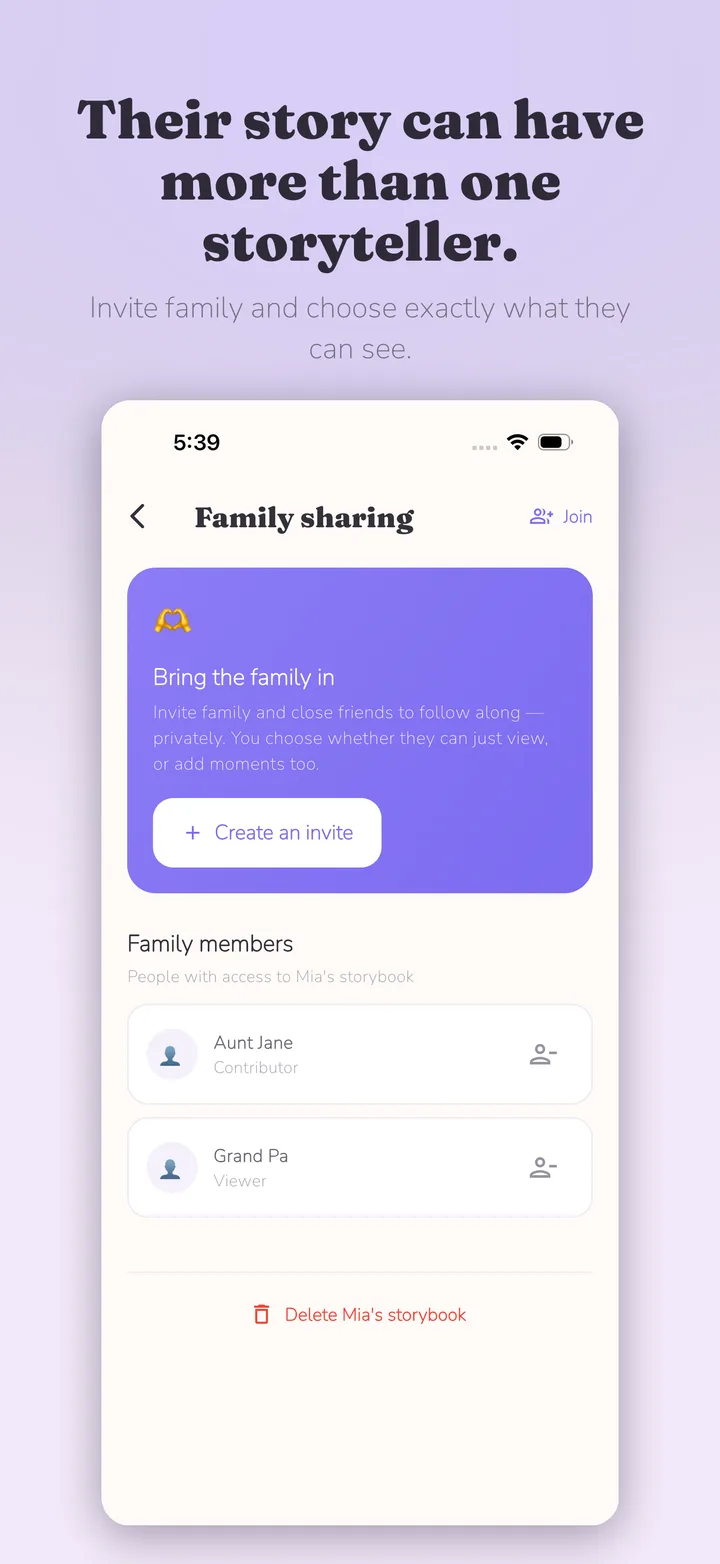
Parents can invite selected family members as viewers or contributors. Family members see only entries tagged for family, not the parent’s whole private journal. That means a grandparent can contribute a story or view selected memories without receiving access to everything.
Selected memories can later become a print-ready PDF. Parents choose an online printer or neighborhood print shop; Kiddings does not print, order, or ship the book. Printer, paper, format, quantity, region, binding, and shipping affect cost and quality, so independent printing is not guaranteed to be cheaper.
Kiddings is one way to organize these accounts, not a genealogy service or a substitute for keeping original recordings elsewhere when those recordings matter to your family.
A 20-minute conversation plan
You do not need a formal interview day.
- Two minutes: explain the purpose, audience, and whether you would like to take notes or record.
- Three minutes: choose one age or period and begin with an easy scene-setting question.
- Ten minutes: ask two or three prompts, following the most interesting answer.
- Three minutes: confirm names, approximate dates, exact words, and what may be saved or shared.
- Two minutes: ask whether another story came to mind and arrange a future conversation only if both of you want one.
Stop while the exchange still feels like a conversation. A second short visit will usually produce better material than extending the first until everyone begins looking meaningfully at the kettle.
Frequently asked questions
Are these questions for interviewing grandparents about their own childhood?
No. They focus on what grandparents remember about your child’s early years and their relationship together. A grandparent life-history interview is a different project.
What if the grandparent did not know my child as a baby?
Begin with the first stage they shared. Grandparent figures, step-grandparents, adoptive relatives, and chosen family may enter a child’s life at any age; do not force an infancy narrative that did not happen.
Should my child join the conversation?
They can, if everyone is comfortable. An older child may add their version or ask a follow-up. Do not ask them to perform gratitude, accept a story they dispute, or discuss private material for the sake of the recording.
What if a grandparent cannot remember exact dates or words?
Use approximate dates and phrases such as “she remembers him saying something like…” Avoid quotation marks when the wording is reconstructed. A clearly attributed partial memory is better than invented precision.
Can grandparents add stories directly in Kiddings?
Parents can invite selected relatives as contributors or viewers. Relatives see only entries tagged for family, not the whole private journal. The parent should still agree on what kinds of stories are appropriate to add and how sensitive details will be handled.
Ask for one scene, not an entire era
The most useful question is rarely “What was my child like?” It is “What happened on those Thursday afternoons?” or “What did she always do when she reached your front door?”
Specific questions give a grandparent somewhere to stand. From there, the snack, the phrase, the small watering can, and the person your child was in that room can come back into view.
Choose three questions. Save one clear story. Let the next conversation begin when another memory arrives.

Start with one moment today.
Kiddings is a private, ad-free storybook for your child’s words and little moments.