Memory Keeping
How to Make a Year-in-Review Book for Your Child
Disclosure: This guide was written by Kiddings, an app for preserving childhood stories. The method works with a paper journal, folders, a document, a photo-book service, or another memory system.
Make a child’s year-in-review book with meaningful stories, a practical 20-page plan, caption tips, a 60-minute version, and a checklist for printing.
A child’s year-in-review book is not a complete archive of everything that happened. It is a short, readable story of who your child was during one particular year.
The simplest method is:
- Choose the year’s boundaries.
- Gather a small set of possible memories.
- Select a balanced mix of Quotes, Questions, Moments, and Milestones.
- Add the ordinary routines, relationships, and interests that made the year recognizable.
- Invite your child’s version where appropriate.
- Arrange the memories into a beginning, middle, and ending.
- Review the final book for names, dates, privacy, and print quality.
That is the whole project. You do not need 365 entries, twelve equal monthly chapters, or evidence that every weekend was enriching. February is allowed to have happened without a themed spread.
Decide what “the year” means
A year-in-review book can follow:
- the calendar year, January through December;
- a school year;
- one birthday to the next;
- a family period such as “our first year in the new home.”
Choose the boundary that makes the story easiest to understand. A school-year book suits classroom changes, friendships, and activities. A birthday-to-birthday book keeps the child’s age consistent. A calendar year works well for an annual family tradition and year-end printing.
Write the date range on the cover or opening page. “Maya’s Year: January–December 2026” will make more sense later than “This Year,” a title with a surprisingly brief shelf life.
If the dates are incomplete, use the information you genuinely know: month, season, school term, holiday, or approximate age. Honest uncertainty is more useful than invented precision.
Start with stories, not every photograph
The camera roll is a source, not the book outline. If you begin by choosing from thousands of photos, you may spend an hour comparing nearly identical playground images and emerge with a strong opinion about image 4,823 but no story.
Start by listing ten to fifteen memories from the year. Look in:
- your childhood journal or notes;
- favorite or tagged entries;
- calendar events;
- family messages;
- school or activity dates;
- photographs and short videos;
- artwork, letters, and small paper keepsakes;
- relatives’ memories, with permission.
Write one line per memory. Do not design pages yet.
Kiddings organizes childhood stories as Quotes, Questions, Moments, and Milestones, with child and age context. Search, filters, favorites, and tags can help parents find likely book selections. Photos, video, and voice support the story, but a printed year-in-review still needs a clear written account of what happened.
Use four story types to avoid a photo dump
An annual book becomes more interesting when it contains different kinds of memories.
Quotes
Choose one or two lines that sound unmistakably like your child at that age. Include the setting and what prompted the words.
Weak caption:
Funny thing Leo said.
Useful caption:
At age six, while packing for the beach, Leo held up a wooden spoon and said, “This is for emergencies we haven’t imagined yet.” It came with us.
Leo, the quotation, and every named child or scene in this article are fictional illustrations, not customer stories.
Questions
Save a question that reveals what your child was noticing or trying to understand. The answer may matter less than the circumstances in which they asked.
Include their exact words when known. If you only remember the idea, paraphrase it without quotation marks.
Moments
Moments carry the ordinary year: the breakfast routine, the bus-stop game, the weekly visit, the song requested in the car, or the way siblings occupied the hallway while apparently doing nothing.
A year with only holidays and performances can look impressive but feel oddly unlike family life. Include at least one scene that would never have appeared on the calendar.
Milestones
Choose changes that mattered in this child’s life: starting a new place, taking responsibility for something, completing a project, making a friend, learning a practical skill, or leaving a familiar routine behind.
Avoid turning the page into an expected-age checklist or a comparison with other children. Record what changed, what came before, and the scene that made you notice.
Add what made this year different from the others
The annual structure earns its keep when it captures change. Ask:
- What could my child do, choose, explain, or manage differently by the end?
- Which interest took over the household for a while?
- Which person or relationship mattered in a new way?
- What phrase, object, book, meal, game, or place belonged particularly to this year?
- What routine began, changed, or quietly ended?
- What problem did the family learn to handle differently?
- What would immediately date this story to this year?
The answer may be a new school. It may also be the six-month period during which every cardboard tube was classified as “equipment.” Both tell the reader something real.
Let your child help choose—without making it an assignment
The child’s selection may differ from the parent’s. You remember the holiday; they remember feeding a neighbor’s cat on an ordinary Tuesday. That difference belongs in the book.
PBS KIDS suggests making a memory book with your child and choosing important events together. Keep the invitation light:
- “Which three photos feel most like your year?”
- “What do you think I should not leave out?”
- “Which thing are you proud you tried?”
- “What was ordinary then but different now?”
- “Do you remember this differently?”
A younger child might choose a picture, dictate one sentence, or draw the cover. An older child may edit a caption, add a private joke, or ask for a story to be removed. Respect the last request. A family keepsake is not improved by including something its subject reasonably considers private.
Do not require a meaningful answer to every question. “My favorite part was the vending machine” is still their account of the museum visit.
A practical 20-page structure
Use this as a content plan and adapt it to your chosen layout tool or printer’s minimum page count. A shorter or longer book can work; this sequence gives a compact project enough variety:
- Cover: Child’s name, date range, one clear image or drawing.
- Opening note: Two or three sentences about the shape of the year.
- Who you were: Age, current interests, a few concrete details, and a portrait.
- An ordinary day: Morning, school or childcare, afternoon, dinner, bedtime, or another repeating rhythm.
- Quote of the year: Exact words plus the scene.
- Question of the year: What they asked and why it stayed with you.
- People: Family, friends, teachers, neighbors, or others who appeared repeatedly.
- A place: Home, school, a grandparent’s kitchen, a park bench, or the route between them.
- An interest: The subject, game, collection, activity, or character that occupied this stage.
- A project: Something made, practiced, repaired, performed, or finished.
- A change: One meaningful milestone with before-and-after context.
- A small difficulty: A challenge handled, adapted to, or still in progress, without turning the book into a report card.
- Family life: A ritual, meal, journey, celebration, or running joke.
- Sibling or cousin moment: Include only if it belongs to this child’s story and respects the other person.
- Child’s choice: Their selected memory, picture, words, or drawing.
- Something we nearly forgot: An unphotographed or recovered story.
- A quiet ending: A toy, phrase, habit, or routine that faded during the year.
- The year in small details: Five short captions or objects rather than another collage of major events.
- Looking forward: What the child wonders about or wants to try, without turning it into a performance target.
- Closing note: A short parent or caregiver reflection dated at the time of creation.
This is a menu, not a contract. Remove pages that do not fit. Combine thin material. Give an excellent story two pages instead of forcing five photographs onto one.
Write captions that carry the memory
A photograph answers what things looked like. A caption should add what the image cannot show.
Use:
Who + age + date or period + what happened + exact words or telling detail + why it belonged to this year
For example:
Mina, age 9, early spring. She began walking into Saturday art class without asking Dad to wait outside. On the third week she turned at the door and said, “You can have your own morning now.” The photograph shows the doorway; the milestone was the goodbye.
Mina and this scene are fictional.
Keep captions plain enough to read. Avoid describing every visible object or writing a speech under each image. One strong paragraph per page is often more readable than six tiny labels.
Choose photos for story value
The sharpest photograph is not always the best memory. Choose images that establish people, places, routines, and change.
For each candidate, ask:
- Does this support a story already selected?
- Does it show something no other image shows?
- Can the people pictured reasonably be included?
- Is the file good enough for the intended print size?
- Do I know who, where, and roughly when?
Avoid ten versions of the same event unless the sequence is the story. Use a mixture of portraits, wider scenes, details, artwork, and ordinary life. Check the printer’s current image and file specifications before placing an order; do not assume an image that looks fine on a phone will suit a large printed page.
If a photograph belongs to another person, school, or professional photographer, confirm you have permission to reproduce it. Avoid including classmates’ names, school details, addresses, schedules, or private documents unless there is a clear reason and appropriate consent.
Build a narrative instead of twelve equal months
Month-by-month can work, but it often gives the year’s least eventful month the same space as a major transition. A narrative structure is more flexible:
- Opening: Who the child was and what family life looked like at the beginning.
- Patterns: Routines, people, places, interests, words, and questions.
- Change: Milestones, projects, challenges, and new independence.
- Closing: What was different by the end, what quietly disappeared, and the child’s own view.
Chronology can still live inside each section. The goal is not to make the year dramatic. It is to help a future reader understand it.
For more on turning saved entries into a coherent physical keepsake, see how to turn family memories into a keepsake book.
Make one book for the family or one per child
A combined family yearbook is efficient for shared events, home changes, trips, and traditions. Separate child books make it easier to center each child’s words, relationships, interests, and timeline.
A practical middle ground is one family book with a short section for each child. Another is separate slim books built from one shared memory collection.
Do not measure fairness only by page count. Aim for meaningful coverage. One child may have a major transition while another contributes the year’s strongest ordinary scenes. If a memory involves siblings, choose the perspective the story mainly follows and name the others in the caption.
A 60-minute version for a busy year-end
If the full process feels like a seasonal administrative department, make a shorter book:
- 10 minutes: list ten memories without opening the camera roll.
- 15 minutes: find one supporting image for six of them.
- 15 minutes: write six captions with child, age, setting, exact words, and context.
- 10 minutes: ask the child to choose one memory or picture, if appropriate.
- 10 minutes: arrange a cover, opening note, six stories, child’s choice, and closing note.
Stop there. A ten-page digital or handmade book containing real stories is complete. If you want commercial printing, check the provider’s minimum page count and adapt the layout. You do not need to expand it into forty pages merely to make it feel substantial.
Using Kiddings for an annual review
Parents can use favorites, tags, search, filters, combined or per-child timelines, and backdating to gather a year’s candidates in Kiddings. Quotes, Questions, Moments, and Milestones remain distinct, making it easier to select a varied set rather than only the entries with the best photographs.
Parents can invite selected family members as viewers or contributors. Family members see only entries tagged for family, not the parent’s whole private journal. A relative can therefore contribute a missing story or view selected memories without receiving access to everything.
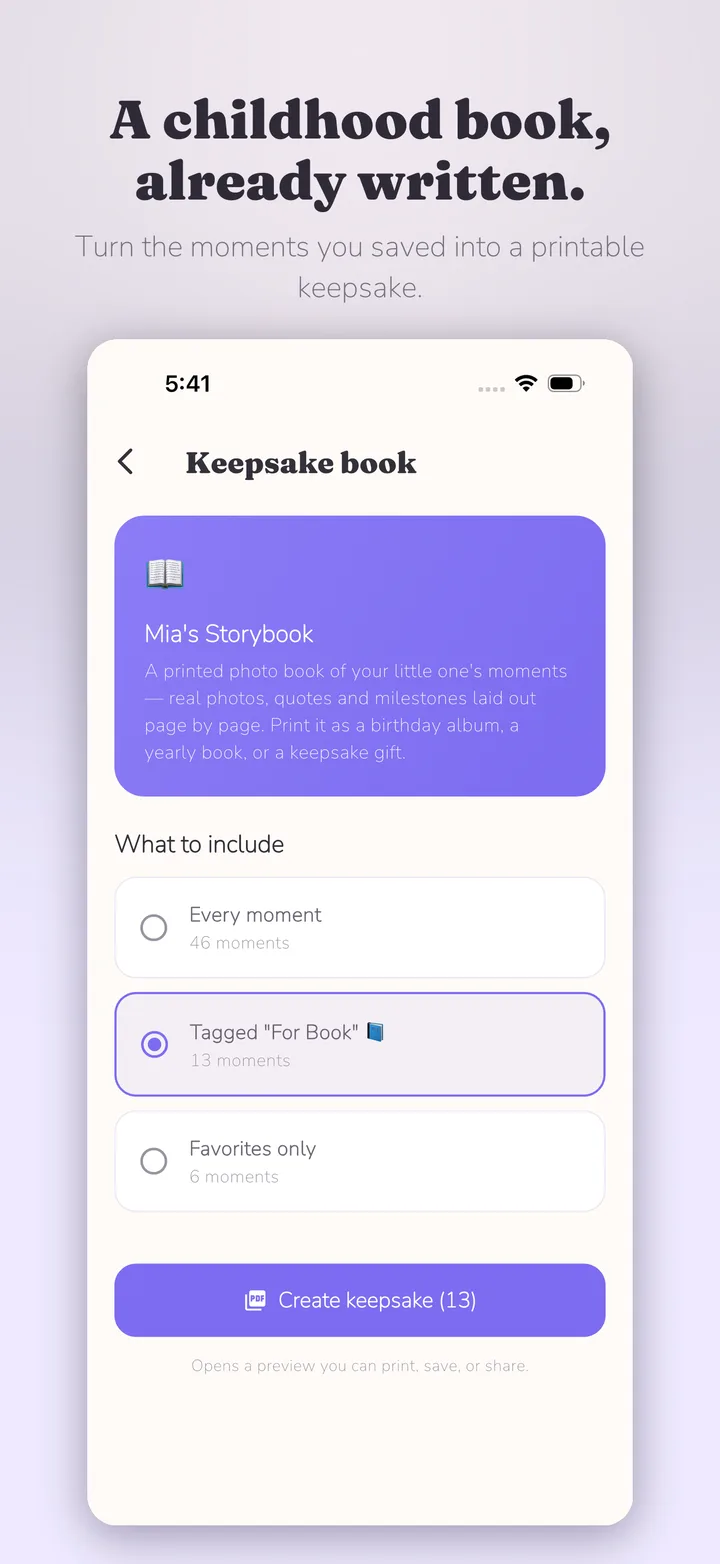
Selected memories can become a print-ready PDF. Parents choose an online printer or neighborhood print shop; Kiddings does not print, order, bind, or ship the book. Choosing a provider may offer more control over format, paper, quantity, timing, and potentially cost, but cost and quality vary by printer, location, specifications, binding, quantity, and shipping. Independent printing is not guaranteed to be cheaper.
The PDF is a printable selection of stories and supporting images. It does not make video or voice playable on paper, and it does not replace the original media files.
Review before printing
Read the final book once as an editor and once as the child’s privacy advocate.
Check:
- names and spellings;
- dates, ages, and clearly marked estimates;
- duplicated stories or images;
- image cropping and print warnings;
- quotations versus paraphrases;
- other people’s private information;
- stories the child asked to remove;
- page order and blank pages;
- printer format, bleed, margins, paper, binding, delivery estimate, and final checkout cost.
Order one copy first when using an unfamiliar printer or format. Review the physical result before ordering several gifts.
Frequently asked questions
How many memories should a child’s year-in-review book include?
Ten to twenty well-told memories can make a substantial book. Use fewer if the stories are longer. Completeness matters less than variety and useful context.
Should the book follow the calendar year or school year?
Either works. Choose the boundary that makes the child’s story clearest, then print the exact date range in the book.
What if I did not keep notes during the year?
Begin with ten memories you can recall clearly. Use calendars, messages, photos, artwork, and relatives as prompts, but label uncertain dates and reconstructed wording honestly.
Should my child write the book?
They can contribute at a level that suits them: selecting images, dictating a line, drawing, editing a caption, or choosing what stays private. Do not turn the keepsake into compulsory reflection or schoolwork.
Can a year-in-review include difficult memories?
Yes, when they belong in the child’s story and can be told with dignity and appropriate privacy. Describe what happened without diagnosing, blaming, or exposing another person’s sensitive information. Not every difficult event needs to become a family keepsake page.
One year, edited with care
A useful annual book does not prove that the family had a remarkable year. It shows what this year felt like from close range.
Choose the question that stopped breakfast. The ordinary route everyone knew. The person who mattered. The project that occupied the table. The milestone that changed the morning. The object that vanished from the travel bag without anyone announcing the end of an era.
Then let the child add the vending machine.

Start with one moment today.
Kiddings is a private, ad-free storybook for your child’s words and little moments.